
Careers Over 50
There is a peculiar thing that happens when you lose your job after 50. Before you have fully processed what happened, the advice begins. Reinvent yourself. Reskill. Learn AI. Refresh your résumé. Build your brand. Network harder. Consult. Start something. Find your purpose.
Most of it is well intentioned, and some of it is useful. But there is an assumption buried inside all that advice: you are the thing that needs to change.
I know the argument because I have lived it. My corporate career ended after more than three decades, and I eventually founded RestlessUrban. Building this company has become some of the most meaningful work of my life. But that does not mean I needed fixing.
I had not forgotten how to lead. I had not lost decades of judgment, experience or curiosity overnight. I did not wake up the morning after my career ended suddenly incapable of doing work I had been doing the day before.
I had lost a job. That is different from losing your value.
The Anxiety is Real
Since I started writing about work after 50, I have heard variations of the same questions from people across very different careers. Does my experience still matter? Am I too senior? Too expensive? Should I remove dates from my résumé? How much of my career should disappear from LinkedIn? What does “overqualified” really mean?
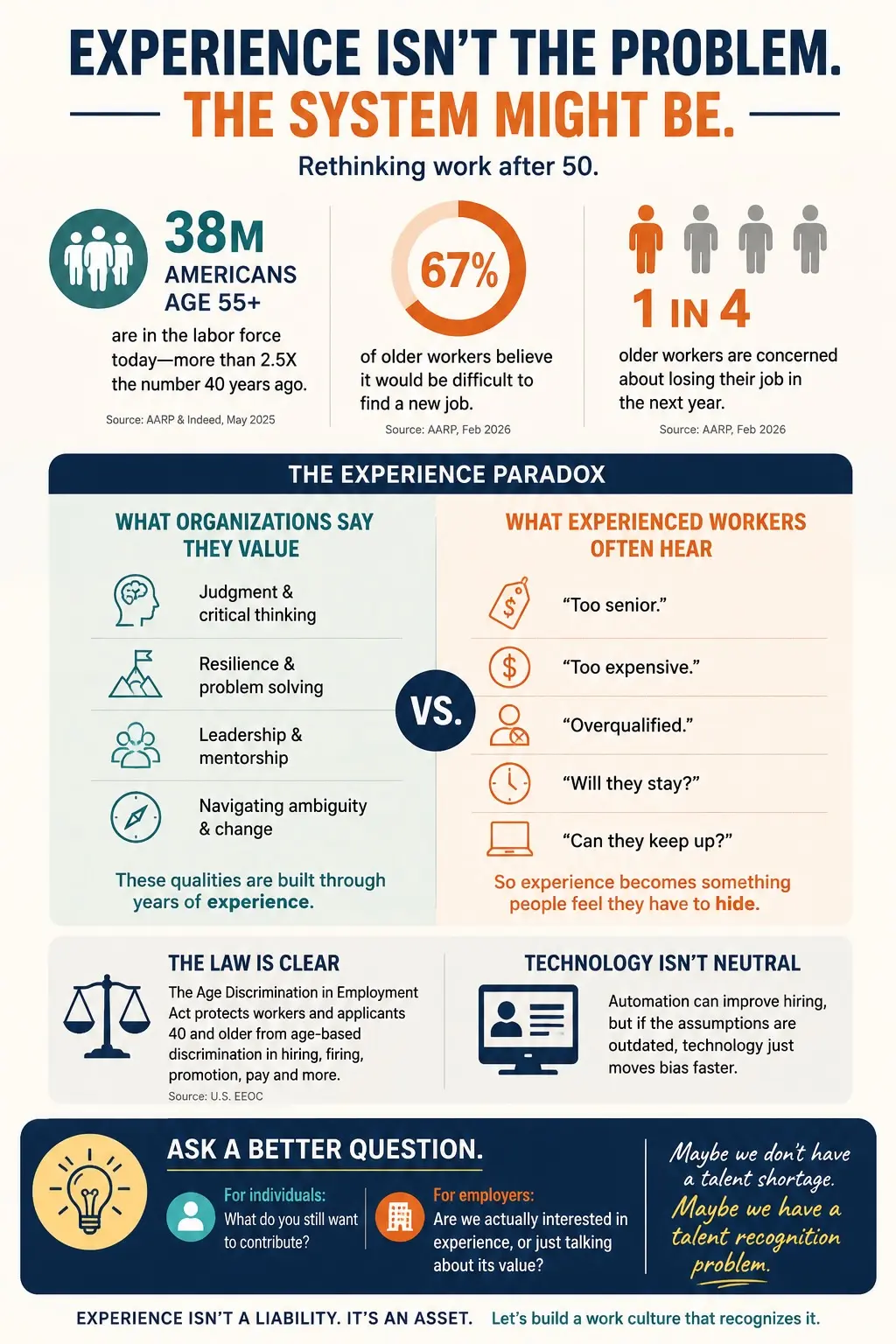
Those questions are especially relevant in today’s labor market. In February 2026, AARP reported that 67 percent of older workers believed it would be difficult to find a new job, with 35 percent citing age discrimination as the main reason they expected difficulty. Nearly one in four were concerned about losing their job within the next year.
This is not a small population. AARP reported in 2025 that roughly 38 million Americans age 55 and older were in the labor force, more than two and a half times the number 40 years earlier. In the same research, 24 percent of workers 50 and older said they planned to make a job change that year.
The Age Discrimination in Employment Act has protected workers and applicants 40 and older from age-based employment discrimination for decades. Congress enacted the law in 1967 in part because older workers faced disadvantages in retaining and regaining employment. More than half a century later, that concern feels remarkably current.
That is where the reinvention narrative starts to bother me.
Adaptation is Not Erasure
People over 50 do not get an exemption from change. The workplace is being reshaped by AI, automation and new ways of working. We need to understand new technology, listen to colleagues with different experiences, challenge old assumptions and keep learning. Thirty years of experience is not permission to stop evolving.
But adaptation and reinvention are not the same thing. A 57-year-old marketing leader may need to understand generative AI. That does not erase decades spent understanding customers. A 61-year-old operations executive may need to learn new systems. That does not eliminate the judgment developed from seeing what happens when systems fail.
Experience and adaptability are not opposites. The best organizations should want both.
The problem begins when someone loses a job and our immediate response is to tell them to become fundamentally different before asking whether the labor market has become too quick to discount what they already know.
The Experience Paradox
Organizations say they want judgment, resilience, leadership, critical thinking and people who can navigate ambiguity. Most of those qualities are acquired the same way: years of making decisions, getting some wrong, solving difficult problems, recovering from failure and learning what to do differently next time.
In other words, through experience.
Then an experienced candidate enters the hiring market and those same assets can suddenly become concerns. Too senior. Too expensive. Overqualified. Will they report to someone younger? Can they keep up? Will they stay?
Some of those questions can be legitimate. Compensation, motivation and organizational structure matter. Employers need to determine whether someone fits a role. But taken together, the questions expose a contradiction:
We say we value experience while experienced people are learning to hide it.
I hear from people who wonder whether to shorten their résumés, remove dates or downplay accomplishments because a long career might make them appear too senior, too expensive or simply too old.
Maybe we do not only have a talent shortage. Maybe we have a talent recognition problem.
Technology Will Not Fix a Cultural Problem
Hiring is also becoming more automated, with technology playing a growing role in how candidates are sourced, screened and evaluated. Automation can make hiring more efficient, but it does not automatically remove the assumptions built into a hiring process.
The EEOC’s guidance on employment practices is relevant here. The agency says employers cannot use otherwise neutral policies or practices that disproportionately harm applicants or employees 40 and older unless those practices are based on a reasonable factor other than age. That principle also applies to selection procedures used in hiring.
As hiring becomes more automated, the question is not simply whether technology can evaluate candidates faster. It is what we are asking the technology to evaluate them for.
If the assumptions underneath the process are outdated, making the process faster does not necessarily make it better.
Not Everyone Needs a Second Act
There is a tendency to make life after 50 sound transformational. The second act. The encore career. Reinvention. Finding your purpose.
Those stories can be inspiring. They are also not everyone’s story.
I started a company after my corporate career ended, and I am grateful for what I am building. But I resist the tidy version in which losing my career was somehow a gift because it forced me to reinvent myself.
Sometimes something painful happens and we build something meaningful from it. That does not mean the painful thing needed to happen.
Not everyone wants to become an entrepreneur, consultant or creator. Some people simply want another job. They want colleagues, responsibility, a paycheck and meaningful work. They want to support their families, save for retirement and use what they spent decades learning while continuing to learn what they do not know yet.
There is nothing small about that. There is dignity in wanting to work.
Ask a Better Question
Adults over 50 are not entitled to jobs because we have experience. We are responsible for staying relevant, learning and adapting like everyone else.
But we should not have to erase ourselves to prove we still belong.
So perhaps the first question after someone loses a job should not be, “What are you going to reinvent yourself as?”
Maybe the better question is: What do you still want to contribute?
Employers, recruiters and leaders should answer their own version of it: Are we actually interested in experience, or do we just like talking about its value?
Because losing a job does not mean someone has lost their relevance. Experience should not become something you have to apologize for.
And that brings me to the next question in this series: When did experience become a liability?
Overqualified. Too senior. Too expensive. The résumé stripped of dates. The interview that never comes. Increasingly, technology deciding who gets through.
If we are serious about the future of work, we should stop asking only how experienced workers need to change.
We should ask whether the system evaluating them is changing fast enough too.


More From the Flip the Script Collection
The casualties aren’t just adults over 50. They’re the companies who missed the memo.

The rules of work have changed. Why do we still believe our best work is behind us?
The rules have changed. Read why millions of experienced professionals are redefining work, purpose and what’s next
Explore why success itself may be the hardest habit to leave behind.
When a career ends, what remains? One executive’s journey from approval to authentic confidence.
A personal reflection on aging, curiosity, and why experience still matters in the future of work.

What happens when the life you built no longer fully reflects who you’ve become?

After decades chasing momentum, Aaron Strout found success answered fewer questions than expected.

A conversation inspired by Geoff Curtis’s Embracing Your Own Purgatory and the search for purpose after 50.
Bob Pearson shows how staying curious turns experience into leverage, impact, and freedom.
Charlene Wheeless shows how choosing visibility becomes an act of impact, not performance.

Reinvention after 50 isn’t about bravery alone. It’s about money, experience, and knowing when the math works.

Three paths. Real stories. See how people over 50 navigate change, purpose, and possibility on their terms.

A milestone birthday, a pandemic, and a château spark an unexpected second act in France.

One marketer’s journey from misunderstanding tequila to honoring its heritage becomes his second act.
When the next title stops mattering, one CMO changes the scoreboard and bets on Gen X.

From billion-dollar boardrooms to boutique jam making, one leader redesigns work to finally serve life.

At 58, he walked away from corporate certainty to build a handmade future, one printed card at a time.

Her daughter said four words that changed everything. Faith Jennings left a VP career and chose life instead.

A startup leap at 52 changed everything. Scott Morris proves reinvention after 50 is messy, brave, and worth it.

Flip the Script is our new series spotlighting real stories of reinvention, freedom, and choice after 50.

Feeling stuck at 50, Paul Sutton found purpose in helping men speak honestly. His journey proves no one is alone.

Singer-songwriter Dean Brandsma rewrites his life’s soundtrack. Hear the story behind the song Crossroads.

How trusting her intuition led to building a mission born from crisis.

Music changed my life. Playing guitar helped me heal, grow stronger, and embrace change.