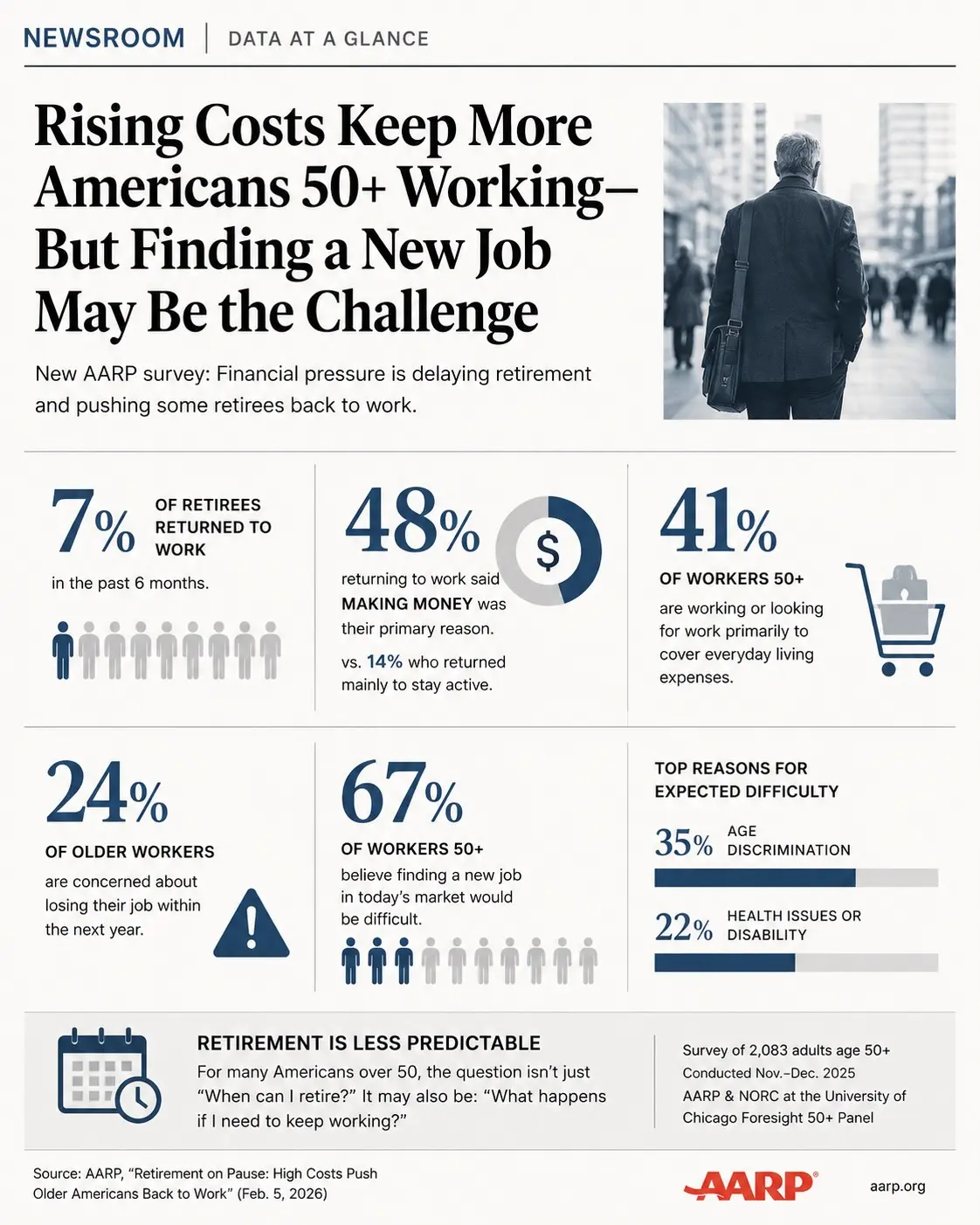
New AARP research finds that financial pressure is keeping older adults in the workforce and bringing some retirees back into it. In the six months covered by the survey, 7% of retirees had returned to work. Among those who did, 48% said making money was their primary reason, compared with just 14% who returned mainly to stay active.
The findings point to a difficult contradiction for older Americans: some need to keep earning at precisely the stage of life when finding another job may become harder.
Among people 50 and older who were working or looking for work, 41% said covering everyday living expenses was their primary reason for doing so. Nearly one-quarter of older workers, 24%, said they were concerned about losing their job within the next year.
Finding Another Job Is the Bigger Concern
The most striking number may be 67%.
More than two-thirds of older workers surveyed said they believed finding a new job in the current market would be difficult. Among those expecting difficulty, 35% cited age discrimination as the primary reason, while 22% pointed to health issues or disability. These findings come directly from AARP’s survey of adults 50 and older.
That creates a potentially precarious situation for people approaching traditional retirement age. Remaining employed can provide income and allow retirement savings more time to grow. Losing that job, however, may leave an older worker facing a difficult path back into the workforce.
The findings also challenge the assumption that people who work later in life are primarily doing so for fulfillment or social connection. While those motivations exist, AARP’s survey indicates that economics are playing a much larger role for many older adults.

Retirement Is Becoming Less Predictable
The research was conducted using AARP and NORC at the University of Chicago’s Foresight 50+ panel. Interviews took place in November and December 2025 and included 2,083 adults age 50 and older. The results were weighted to represent the U.S. population 50-plus. Full survey details are available through AARP’s original research release.
The findings don’t mean retirement is disappearing, nor do they suggest everyone over 50 will need to work longer. They do show that the boundary between working and retirement is becoming less predictable for some Americans.
For experienced workers, that makes career resilience increasingly important. Staying employable, maintaining professional relationships and continuing to develop relevant skills may matter well beyond the age when previous generations expected their careers to wind down.
For many Americans over 50, the question may no longer be simply, “When can I retire?”
It may also be: “What happens if I need to keep working?”
Source: AARP, “Retirement on Pause: High Costs Push Older Americans Back to Work”


More Research

New research shows it is essential for fostering healthy aging and supporting longevity.

With the use of a mere five drops of blood, now possible for a person’s true biological age to be determined.

Research indicates travel enhances physical health, cognitive resilience, and social engagement.

A new global survey uncovers the many ways pet cats and dogs impact our daily wellbeing.

New study highlights how digital platform can uncover problems even before symptoms emerge.

Cats are outpacing the dogs when it comes to pet adoption, according to new statistics released by PetSmart.

New findings show many Americans face financial stress from inflation and rising cost of living.

Study shows engagement with the devices leads to better cognitive health outcomes.