Published
At a glance
- “Wired for Purpose” draws on Aaron Strout’s experience with changing technology to explore work, AI and the human choices that shape a career.
- The review highlights the Connector’s Code, an approach to networking built around helping others without keeping score.
- It also considers legacy as the result of everyday decisions, with the book’s practical perspective complemented by Melanie Strout’s personal view in the preface.

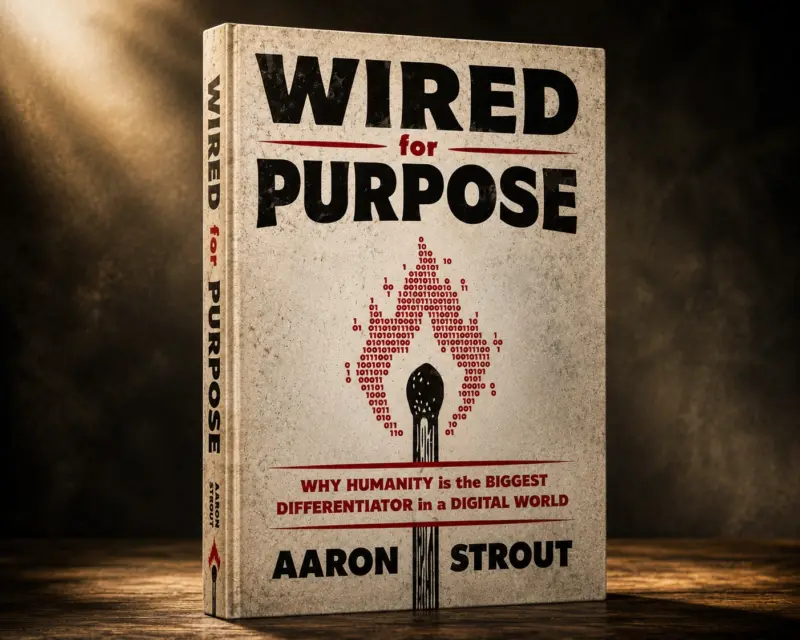
Wired for Purpose calls itself a field manual. In a genre that can’t stop sloganeering about AI, that’s a quietly radical claim.
Aaron Strout spent 30 years one curve ahead of the technology adoption cycle. He taught himself HTML in 1994 and built one of the early websites. He ran banner ad campaigns and email campaigns at Fidelity when both were still novelties. He launched a podcast in 2006, before the iPhone existed and before “podcast” had a dictionary entry. He was among the first wave of generative AI users. The book is what he learned along the way, written as a letter to his former self.
Strout took the proposed title to a LinkedIn poll. His wife Melanie voted against it. He overruled her, so she got to write the preface. She used it well. “The preface, if we’re being honest, is my favorite part of the book,” he told me. I cautiously agreed.
Her opening and his chapters are two registers of the same conversation. Hers is warm and observant, the view from across the breakfast table. His is practical and earned, the view from inside the room. Together, they tell you more about him than either would alone.
The framework that earns its keep is the Connector’s Code: networking as service, not transaction. Make the introduction. Take no ledger. Step out of the way. It isn’t new advice, but it feels more authentic than some because Strout has built a career living it.
Legacy, according to Strout, isn’t built at the end of a career. It’s built through daily practice: the thousands of micro-decisions, how you treat the intern, whether you cut corners, and how you speak in moments of anger. Each one, he writes, leaves “fingerprints on a future you will never see.”
When we talked, he put it more plainly: “How do you do things that will leave a permanent and positive impression on humankind? That’s what I’ve been thinking about a lot lately.”
Humanity is the differentiator, Strout argues. The tools accelerate. The people decide. He knows it because he spent 30 years learning it the slow way, and he’s written the book he wishes someone had handed him at 27.
Get the book here or at your favorite independent bookstore.
To learn more about Aaron’s story, check out our feature here.
Read next





More Reviews about Mindfulness

Books for life after 50: curated memoirs, fiction and practical reads on reinvention, well-being and growth.

Book review: “The Mind of a Dog” uses science and comics to explore canine behavior and first-time pet ownership.

Saturn Press letterpress greeting cards: traditional printing, hand-mixed inks and distinctive paper.

Book pick: “Gen X: The X Factor for Growth” explores the generation's workforce role and spending power.

Business with purpose: Camille L. Miller brings together 25 stories and strategies from entrepreneurs.

Curiosity University online courses: expert-led video lectures for lifelong learning, without exams.

Book review: Mel Robbins' “The Let Them Theory” explores boundaries, people pleasing and relationships.

Creative workshops, coaching and fitness classes: explore experiences for learning and growth after 50.