
How hard could it be to run a retreat business in a 14th-century French château you bought during COVID?
Trish Jasinski is 18 months into finding out.
After living in Paris for more than a decade and getting tired of city life, staring at four walls in her tiny Paris apartment during the COVID lockdown, Jasinski put her apartment on the market with thoughts of moving elsewhere. She got more than she expected.
That’s when friends separately made offhand comments that planted the seed. One said she could buy a château for what her Paris apartment cost. Another, over virtual cocktails, asked what she’d do for her 50th birthday now that COVID had canceled her big plans.
Most people would have just poured another drink. Trish started idly researching properties in southwest France.
She had spent 10 months looking at more than 30 apartments before she found her Paris place. The third château she visited was love at first sight. King Henry IV’s former hunting lodge had stone walls, a spiral staircase, and a tower. She made an offer the same day
“When the real estate agent handed me the keys, he said ‘Félicitations, Madame Châtelaine,’” Trish recalls. “Suddenly I had a title. First I was surprised, then excited about living in the most interesting place ever, then hoped it wasn’t haunted.”
The accidental cascade
None of this was the plan.
Trish had climbed Kilimanjaro for her 40th birthday. She wanted something equally memorable for 50. So she found herself on a château shopping trip.
Then the bank processed her loan as a primary residence instead of an investment property. She had to move in. She found herself living in a village where sheep outnumber people two to one.
She was still working her corporate marketing job remotely when organizational changes gave her an exit opportunity. She could start the retreat business she’d been considering.
Her father’s advice guides her: “Don’t get into anything you can’t get out of.” She could sell the château. She could return to corporate work. Having Plan B makes the risk bearable.
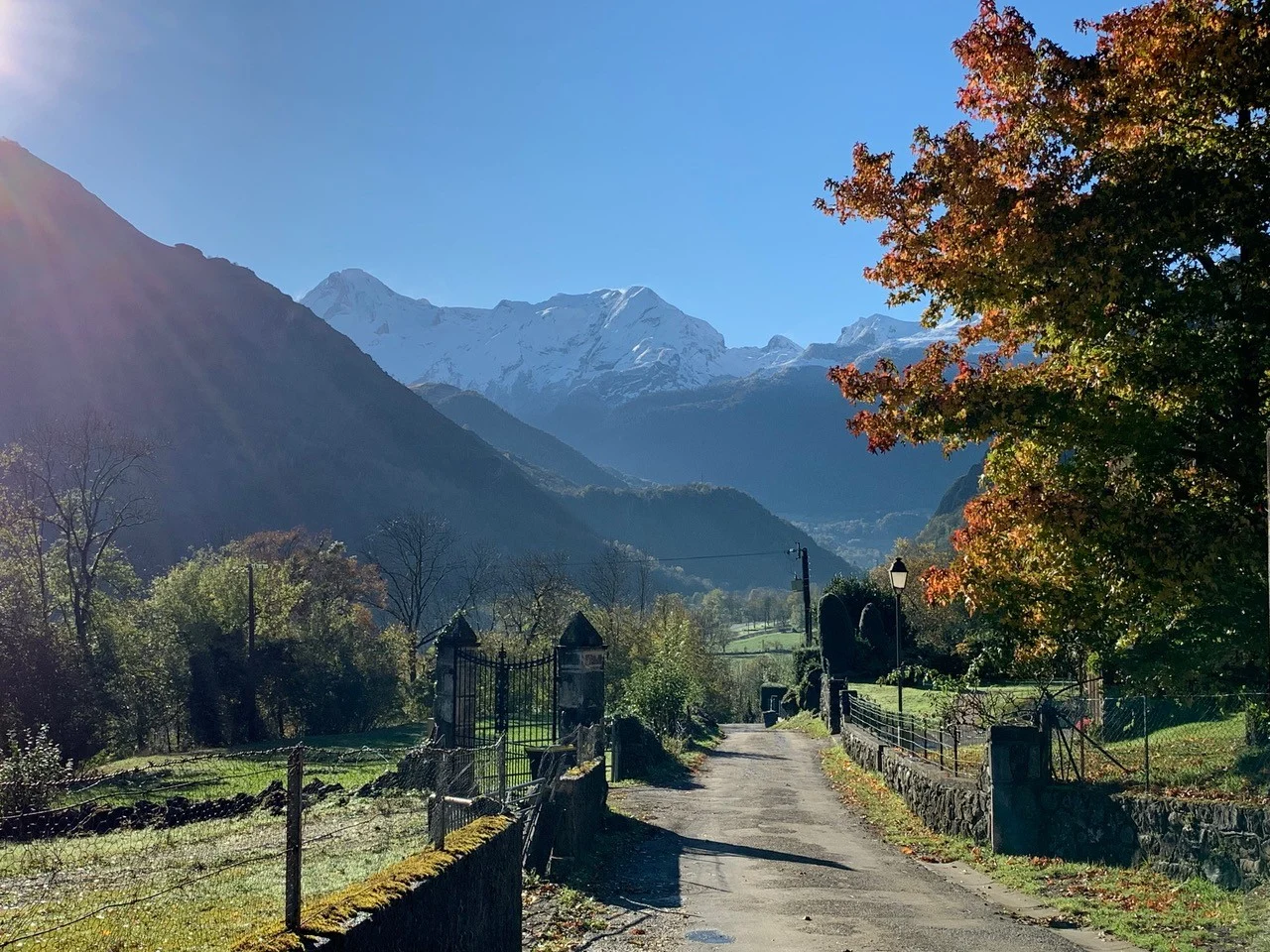
Looking down the road towards the mountains from the end of her driveway.
How hard could it be?
Her friends joke about Trish’s approach to problems.
One decision cascaded into the next. Madame Châtelaine quickly transitioned from sitting behind a laptop 10 hours a day in the city to preparing for guests and focusing on outdoor maintenance.
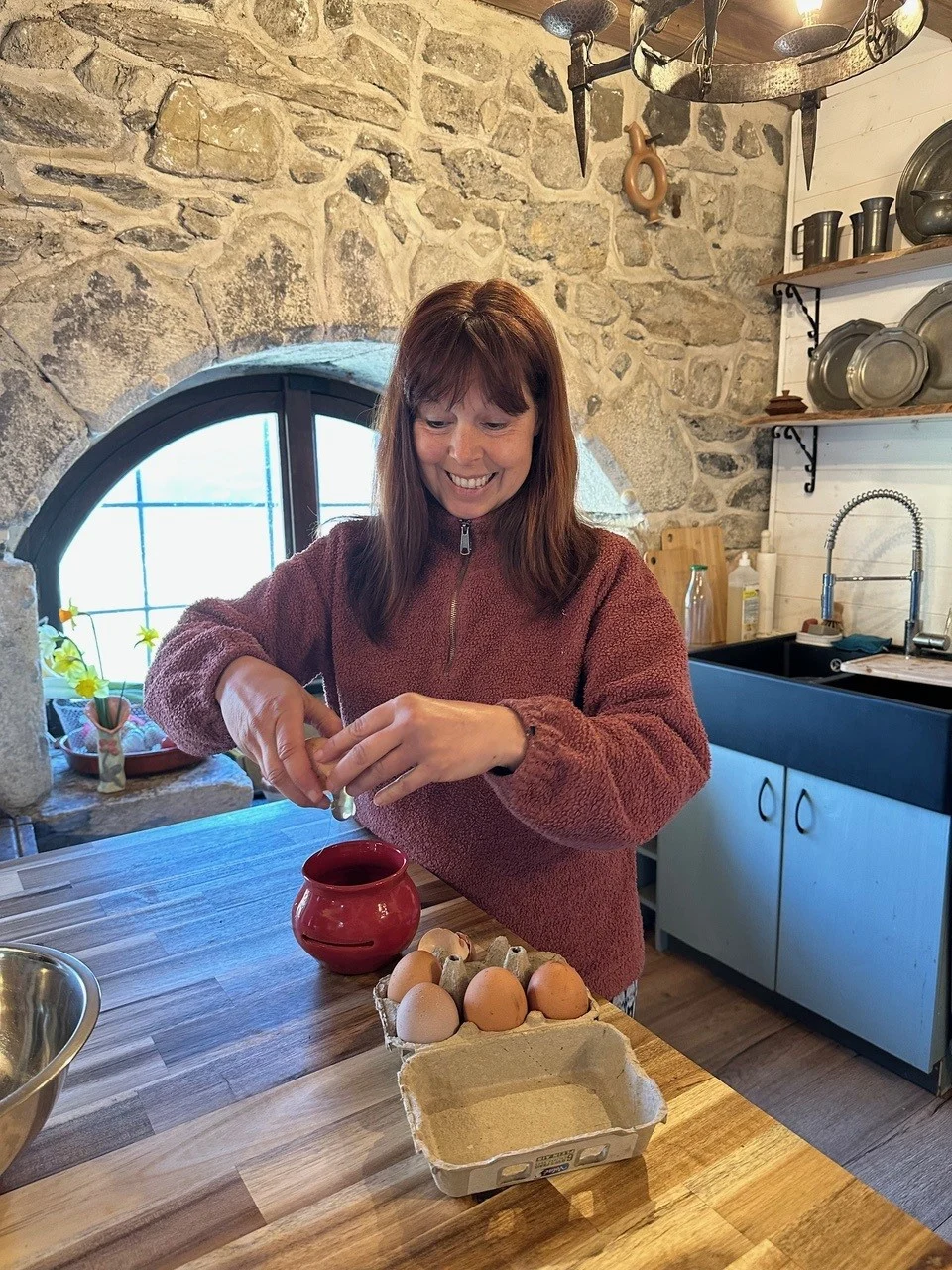
Wanting to upgrade her cooking skills for guests, she earned her certification at a French cooking school where the classes were all French. She wasn’t fluent when she started and admits she’s still learning.
When a dead tree threatened to fall on the house during high winds, she hired professionals to cut it down. Then she looked at the massive trunk and branches scattered across her property and thought: How hard could it be to clear this myself?
It took months. She bought a chainsaw, cut what she could, and hauled what she couldn’t. She pushed 50 cm-wide chunks down an embankment with her legs because she couldn’t lift them. She cut smaller branches, tried making a fence from them, watched the untreated wood disintegrate, then turned everything into wood chips for her garden.
“A lot of times it doesn’t turn out the way it’s supposed to, but that’s all right because I still feel that sense of accomplishment and eventually it gets to a place where I’m happy with it.”
The deck around her pool was old and needed to be replaced. She ripped up the boards and found rotting wood underneath. The cement base was angled. Everything had to line up precisely. She put all the boards down, screwed them in, realized they didn’t extend far enough and needed to be staggered for stability.
She ripped it up and started over.
When the bridge across her stream fell apart, she watched YouTube videos and built a new one using reclaimed wood. It’s been standing for more than a year.

Life in sheep country
More than 400 sheep graze on her property. Her neighbors make Ossau-Iraty cheese from their milk. Sheep traffic jams in town are routine.
The families who’ve lived there for generations welcomed her despite her strong American accent and imperfect French. She didn’t expect that. French cooking school became as much a language lesson as a culinary education. Navigating French business regulations and tax structures while still learning the language meant figuring things out the hard way more than once.
“There’s certain things that, looking back, I wish I knew sooner,” she says. “A few lessons I’ve learned the hard way, but I’m figuring it out.”
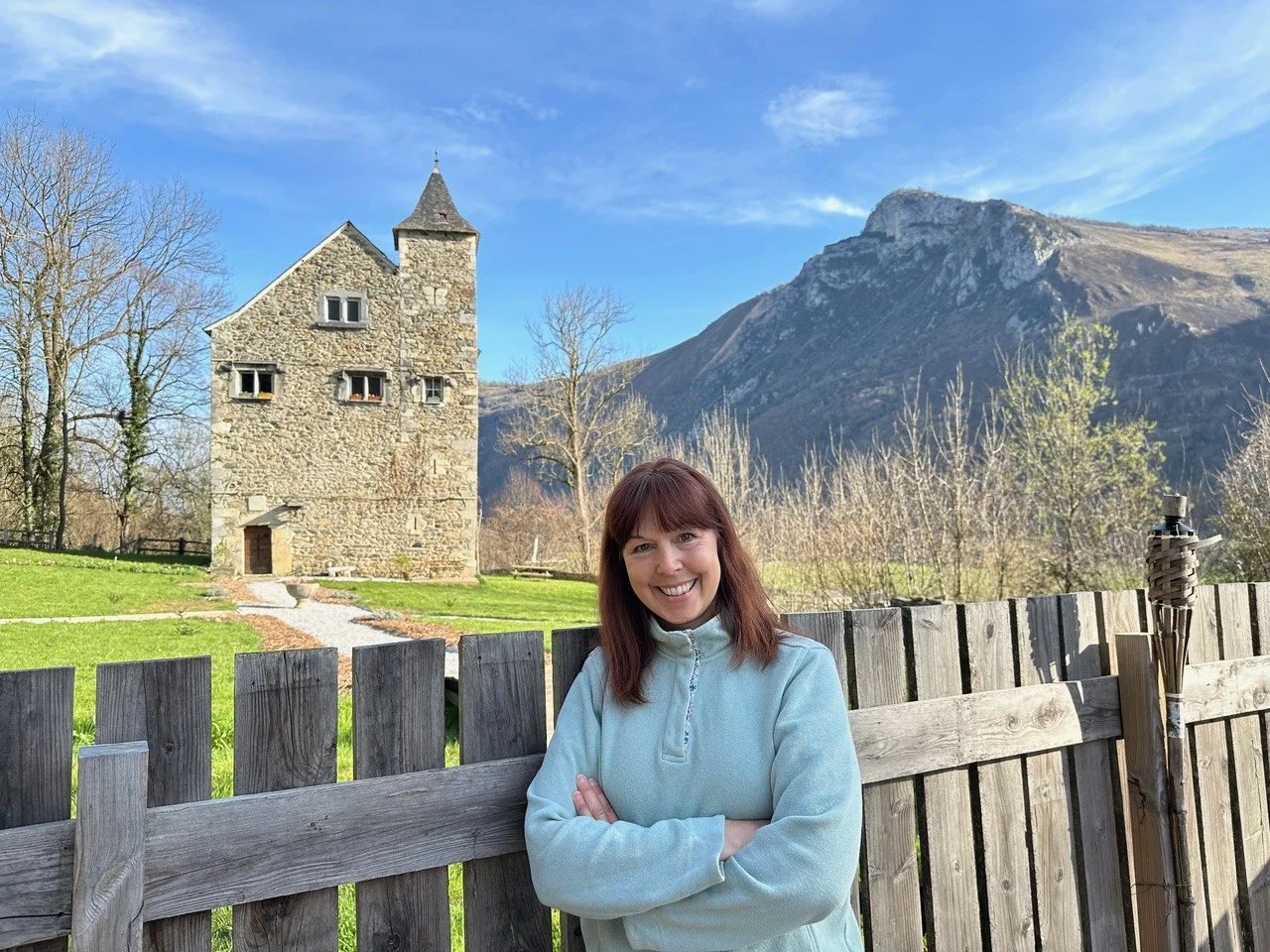
Madame Chatelaine outside her 14th-century château.
The daily reality
The retreat business is building more slowly than projected. With only four guest rooms, even strong bookings have natural limits (she admits to a bit of “chateau envy” for competitors with more rooms). Château maintenance has a way of surprising you when roof tiles fall and hornets build nests. Running a hospitality business in France, in French, requires navigating structures and regulations she hadn’t fully anticipated.
But each morning, she throws open the shades and peers out at the Pyrenees backdrop, the pool, the stream, and the bridge she built. “I pinch myself because I feel so lucky to be where I am.”
Then she gets to work. Five acres of fast-growing weeds. DIY projects instead of high-cost professional repairs. Light plumbing. All the things she never imagined doing when she sat in corporate meetings in Paris. Some days it’s hornets and roof repairs and adjusting the business model. Other days it’s sunrise over medieval stone walls and sheep grazing in her field.
Three years from now, she envisions a steady stream of customers for memorable experiences that are sustainable and profitable.
People saw her early in her journey on a French château renovation TV show. They email her saying watching her tackle these projects inspires them.
Her advice to others contemplating similar leaps: “Making big changes in your life doesn’t have to be fully planned out. Sometimes it’s just being curious and open to potential opportunities and seeing where it takes you.
Because how hard can it be?
More From the Flip the Script Collection
The casualties aren’t just adults over 50. They’re the companies who missed the memo.
Losing a job after 50 shouldn’t mean reinventing who you are. Maybe it’s the system that needs to change.
The rules of work have changed. Why do we still believe our best work is behind us?
The rules have changed. Read why millions of experienced professionals are redefining work, purpose and what’s next
Explore why success itself may be the hardest habit to leave behind.
When a career ends, what remains? One executive’s journey from approval to authentic confidence.
A personal reflection on aging, curiosity, and why experience still matters in the future of work.
What happens when the life you built no longer fully reflects who you’ve become?
After decades chasing momentum, Aaron Strout found success answered fewer questions than expected.
A conversation inspired by Geoff Curtis’s Embracing Your Own Purgatory and the search for purpose after 50.
Bob Pearson shows how staying curious turns experience into leverage, impact, and freedom.
Charlene Wheeless shows how choosing visibility becomes an act of impact, not performance.

Reinvention after 50 isn’t about bravery alone. It’s about money, experience, and knowing when the math works.

Three paths. Real stories. See how people over 50 navigate change, purpose, and possibility on their terms.
One marketer’s journey from misunderstanding tequila to honoring its heritage becomes his second act.
When the next title stops mattering, one CMO changes the scoreboard and bets on Gen X.

From billion-dollar boardrooms to boutique jam making, one leader redesigns work to finally serve life.
At 58, he walked away from corporate certainty to build a handmade future, one printed card at a time.
Her daughter said four words that changed everything. Faith Jennings left a VP career and chose life instead.

A startup leap at 52 changed everything. Scott Morris proves reinvention after 50 is messy, brave, and worth it.
Flip the Script is our new series spotlighting real stories of reinvention, freedom, and choice after 50.

Feeling stuck at 50, Paul Sutton found purpose in helping men speak honestly. His journey proves no one is alone.
Singer-songwriter Dean Brandsma rewrites his life’s soundtrack. Hear the story behind the song Crossroads.

How trusting her intuition led to building a mission born from crisis.
Music changed my life. Playing guitar helped me heal, grow stronger, and embrace change.