


New Study Shows Higher Levels of Loneliness and Depression
This morning at 8:30 am, I was still in bed.
Not asleep. Just lying there, staring at the ceiling, negotiating with myself about getting up.
There was no crisis. No illness. Just that quiet resistance that shows up some mornings now. A heaviness that feels more mental than physical. The kind of pause that makes you wonder when starting the day began to require intention.
A friend had sent me an article from ScienceDaily about a new study examining Americans in their fifties and early sixties. I read it on my phone, propped against the pillow.
It resonated immediately.
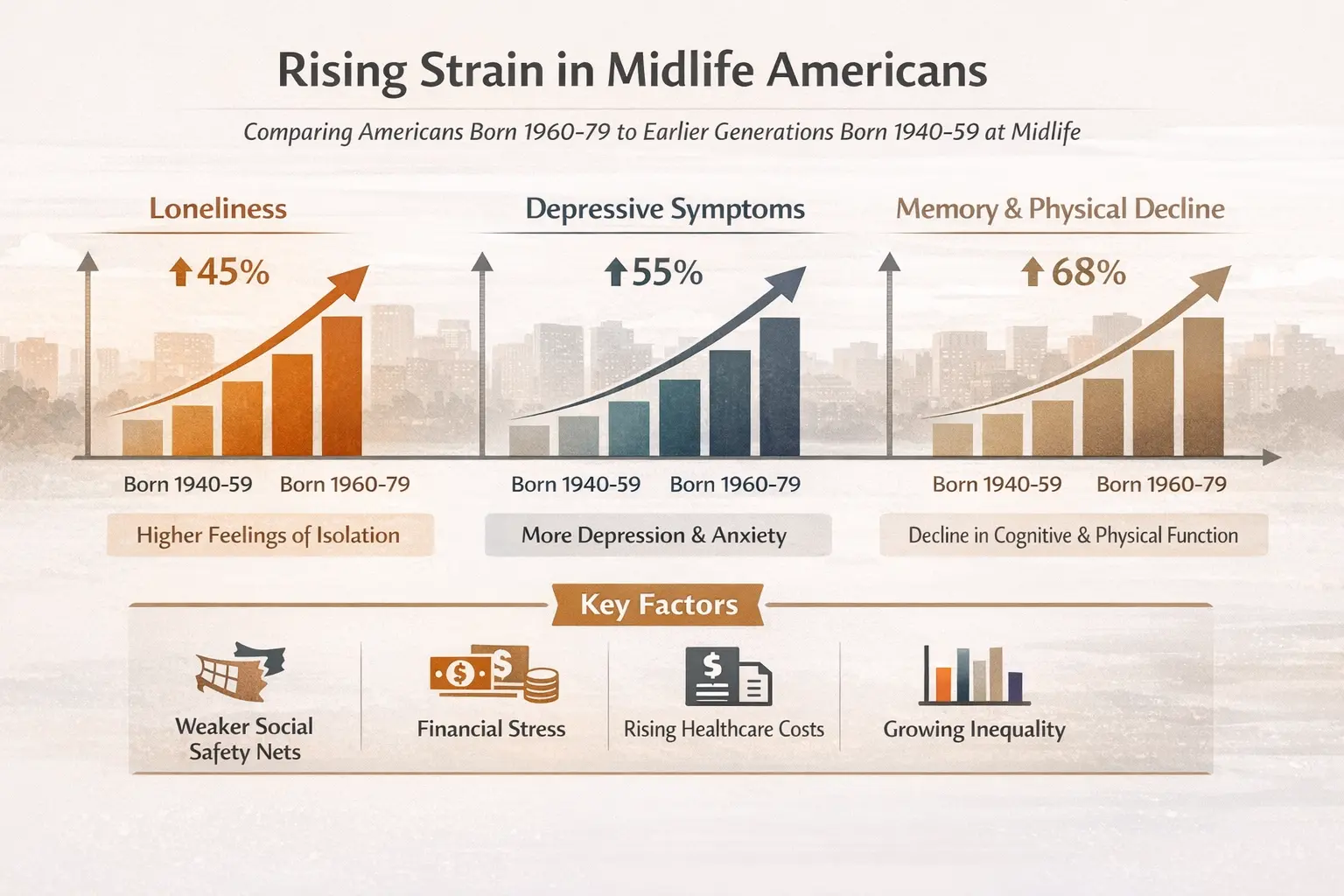
The research described higher levels of loneliness, more depressive symptoms, and measurable declines in memory and physical strength compared with earlier generations at the same age. It was clinical. Measured. Data driven.
But it didn’t feel abstract.
I texted him back.
“The article hits home with me as I lay in bed just like Brian Wilson did.”
He responded quickly.
“If you are working on the next Pet Sounds you are okay.”
I stared at the screen for a moment before replying.
“I am not.”
It was not self pity. It was simple honesty. I was not composing a masterpiece. I was just lying there at 8:30 in the morning, trying to summon momentum.
And then something shifted.
If I was not creating Pet Sounds, I could at least write about why this article struck such a nerve. I could explore what it means for so many people navigating this stage of life. I could ask the questions the study raises but does not fully answer.
Suddenly, I had a reason to get up.
What the Might Actually Be Saying
The article that prompted this reflection was published on ScienceDaily and can be found here.
It reports on the research paper Historical Change in Midlife Development from a Cross National Perspective, published in Current Directions in Psychological Science by Frank J. Infurna and colleagues.
The researchers analyzed longitudinal data from 17 countries and found that Americans born in the 1960s and early 1970s are reporting more loneliness, higher depressive symptoms, and measurable declines in memory and physical functioning compared with earlier generations at the same age.
Even more striking, this pattern is not nearly as pronounced in several other wealthy nations.
The authors point toward structural factors. Weaker social safety nets. Greater financial pressure. Rising healthcare costs. Increasing inequality. Chronic stress accumulating over time.
One line stands out.
“Education appears to be becoming less protective against loneliness, depressive symptoms, and cognitive decline.”
For a generation raised to believe that preparation and hard work would secure stability later in life, that is not a small statement.
Why This Feels So Familiar
At RestlessUrban, we talk daily with people in their fifties and early sixties. The language is rarely dramatic. No one says they are collapsing.
What they say is this.
I thought this stage would feel easier.
Many expected a soft landing after decades of building careers and families. Instead, they find themselves carrying more than anticipated.
Careers are still demanding. Retirement feels less certain. Parents need care. Adult children sometimes still require support. Health is no longer theoretical. It is present.
It is not a breakdown.
It is load.
And load accumulates quietly.
Shared Life Experiences Beneath the Data
The study uses precise terminology. Psychosocial resources. Episodic memory. Depressive symptoms.
Real life sounds more like this:
I am capable but I am tired.
I have achieved a lot but I am reevaluating everything.
I am surrounded by people but sometimes I feel alone in the responsibility.
These are not failures of character. They are shared experiences of a generation navigating longer working lives, shifting economic realities, and thinner automatic community structures.
The researchers emphasize that these outcomes are not inevitable. Strong social connections, a sense of agency, and positive views on aging can buffer stress.
That matters.
Because it means the story is not predetermined.
The Part the Numbers Cannot Capture
Data can measure loneliness. It cannot easily measure perspective.
Many people in this stage of life are also becoming more honest. More selective. More intentional.
They are questioning old definitions of success. They are protecting their energy. They are asking what truly sustains them physically, socially, and intellectually.
The same years that feel heavier can also feel clearer.
And clarity often arrives through friction.

The Real Question
Lying in bed at 8:30 this morning, I was not producing a masterpiece.
But I was recognizing something.
If so many Americans in this age group are reporting more strain, perhaps it is not simply a personal issue. Perhaps it reflects a redesign in motion.
Maybe the expectations no longer fit the conditions.
Maybe we are being asked to rebuild community more intentionally. To rethink work not as identity but as contribution. To approach health not as avoidance but as investment.
The study gives us data.
What we do with it is still up to us.
For me, it was enough to get out of bed and start writing.
Not because I had all the answers.
But because the question felt worth exploring.
And that, at least for now, feels like a reason to begin the day.
More Features about Wellness


Join RestlessUrban to explore health, career, intimacy, and purpose in the search for meaning after 50.

Founder Andrew Bowins shares the story behind the creation of RestlessUrban.

Navigating sleep, sex and intimacy at middle age.

It's time for a new measure of wealth when it comes to our wellbeing.

A strong morning routine can set the tone for the entire day.

There’s something about sudden loss that not only breaks your heart but also scrambles your sense of what matters.

Rediscover intimacy after 50 with real talk on sex, connection, and wellbeing.