Steven Tyler and Joe Perry with Aerosmith, Arnhem, Netherlands, June 23, 2010. Photo: Julio Aprea / Wikimedia Commons, CC BY-SA 2.0.
Published
At a glance
- Bob Pearson reflects on how concerts, records and shared listening become markers of a life, connecting music with identity and belonging.
- Research describes music-evoked autobiographical memories and a reminiscence bump, although patterns vary and vivid recall is not a guarantee of accuracy.
- Songs from youth have years of associations behind them, while new music can still become meaningful.
Why the music of our youth never really leaves us
After school one day, we hopped on a train in Millburn, New Jersey, and soon arrived at Madison Square Garden to see Aerosmith—my first concert, at 15. We pushed our way up to the front fence to listen to Steven Tyler and Joe Perry in their prime.
When we left the concert, I realized I could not hear. We had been right in front of a speaker tower all night. I had basketball practice the next day and went through the entire practice without hearing a thing. I was prepared to head home and tell my parents I had gone deaf when, all of a sudden, my hearing returned. Thank God!
Music has a way of sticking with us. It becomes part of our lives because it helps us remember the stories of our lives.
Whether it is a favorite album, a song tied to a long-ago breakup, a new sound on the radio, or putting together images and sound for the first time via MTV, music becomes a marker of our lives.
I remember, like it was yesterday, convincing a neighbor to let me rake their leaves for $5. Then 12-year-old me walked about two miles to the local record store. I felt a little out of place entering such a hip place but had enough cash to buy an album: Led Zeppelin’s Physical Graffiti.
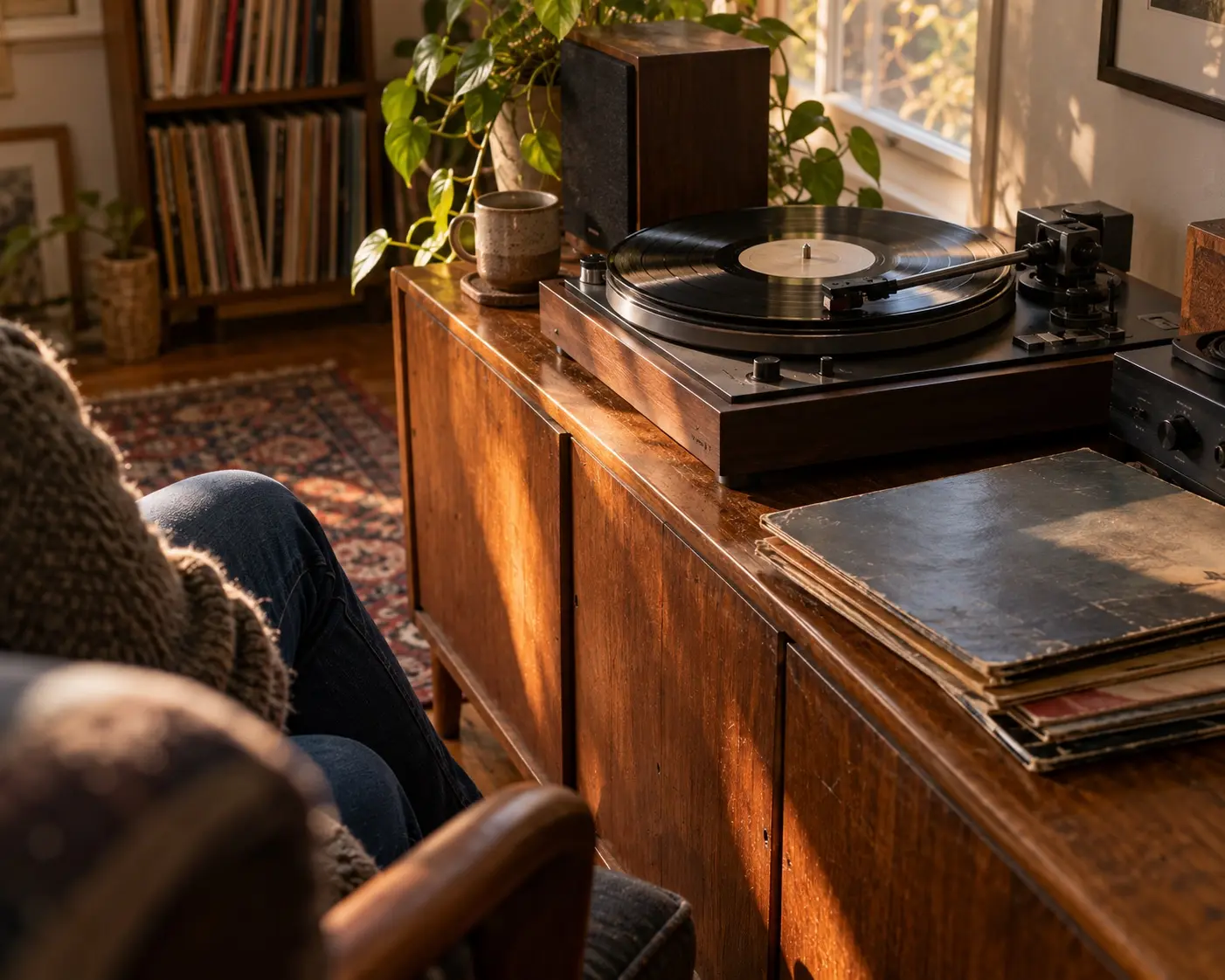
Revisiting a favorite record. AI-generated illustration for RestlessUrban.
What has always impressed me is how music can bring us together.
One scene that sticks with me is traveling to Warsaw with our family to see The Rolling Stones at PGE Narodowy. The July 8, 2018, concert closed that year’s European leg of the No Filter tour. Around me, thousands of people sang along in English. Every word, it seemed, of every song.
On that summer night, I felt a sense of freedom in the air as we listened to Mick, Keith, Ronnie, Charlie and Chuck play song after song on the soundtrack of our lives. It reminded me that the Stones had played Warsaw in 1967, during the Iron Curtain years. Decades later, here we were, singing together.
So why is music so powerful? Why does it bring us together worldwide? And why do some of these memories stay with us for so much of our lives?
Let’s explore.
How songs bring back personal memories
Music can feel intensely personal because it becomes associated with experiences that matter to us. Growing up, we were filled with emotion; we listened to our favorite songs continually; music was a social currency with friends; and the songs often spoke to us as we were becoming ourselves. They helped us deal with and explain life.
As I write, I hear Bob Seger’s “Night Moves” wafting through the air, and I am immediately remembering summers in New Jersey.
A song’s melody, rhythm, lyric, voice, harmony, tempo and timbre can become cues to memories of people, places, clothes, smells, conversations and feelings. Together, they can transport us. It’s why the background music for a show or a commercial can be such an important choice.
Psychologists call these music-evoked autobiographical memories: personal memories brought to mind by music. They can arrive without a deliberate search. We are not necessarily trying to remember a summer during high school or that first car. But the first seconds of a song can open up our stories.
Why the music of our youth has an advantage
When Mick Jagger sings “Time Is on My Side,” I like to think the title applies to music, too.
Research on autobiographical memory has long identified a “reminiscence bump”: adults often recall a disproportionate number of experiences from adolescence and early adulthood. The pattern varies with the person and the way memories are prompted; it is not a rule that later experiences matter less.
Those years are filled with firsts: independence, strong friendships, first romance, school, first jobs, first trips on planes and trains, problems, tragic loss and more. All while we are figuring out who we are and doing our best to construct our life’s narrative, even if we don’t realize it at the time.
Music becomes woven into these moments. It is the band discovered with friends, the record played at a party, the song on a first date, the concert that felt like a declaration of freedom. These moments become part of the scaffolding of identity.
This helps explain why a song from age 17 can feel different from a song first heard at 47. The earlier song is also about who I was when I heard it. That does not mean a new song cannot become just as meaningful.
We often discovered music together. We traded albums, debated bands, borrowed records, drove with friends, fell in love, danced, sang, dressed for the scene and went to concerts—even sneaking out to do so.
That’s heavy stuff when you are growing up. When relationships are emotionally important, the songs can inherit some of their significance.
What happens when familiar music plays
The opening of “Kashmir,” with Robert Plant’s unmistakable voice, takes me straight back to Physical Graffiti. I bought that album at Scotti’s Records in Millburn, New Jersey, by the way. There were only two or three people in the store at the time.
Listening to a familiar song can draw on several processes at once: recognizing its sound, remembering an event, feeling an emotion and anticipating what comes next. In a small fMRI study of 13 young adults, Petr Janata found that personally meaningful music engaged brain regions associated with autobiographical memory. It helps explain the connection; it does not show that every listener’s brain responds identically.
This is one of the powerful things about music. We do not simply know a song. We know how it feels to move with it, what it represented socially and who we were when it first became ours.
Repetition gives the song more opportunities to become familiar and to gather associations. A meaningful song may have been heard hundreds of times—on the radio, in bedrooms, in cars, at concerts, during joy and heartbreak. Unlike studying, this kind of rehearsal usually feels like pleasure.
I remember playing this album on a small record player, making sure I had a rag to dust off the record and studying the album cover while I listened.
Music also has a structure we learn to recognize. Beats form measures; phrases build verses and choruses. One lyric pulls forward the next. One chord makes us anticipate a resolution. Familiarity can be deeply satisfying.
Nostalgia can create a loop: we hear the old song, remember the past, tell someone about it and listen again. But a vivid memory is not necessarily an untouched recording of what happened. As research on music and autobiographical memory explores, music is a cue to remembering—not a guarantee of perfect accuracy.
More than old songs
That is why attachment to the music of our youth is not well explained as mere resistance to new music. Many older listeners remain eager for new sounds. The songs we grew up with simply have a head start: years of listening, powerful associations and connections to people and moments that mattered.
To test the power of those connections in my own family, I asked our daughters to name a concert we went to with Andrew Bowins when he lived in Austin. We were both concertgoers and loved to check out bands.
Sure enough, a few seconds later, Nicole mentioned The Dead Weather at Stubb’s. A magical place for Nicole and Brittany, and another amazing set by Jack White.
A beloved old song does not only remind us what happened. It can restore, for three minutes and forty seconds, some part of the person we were when it happened.
And perhaps that is music’s rarest gift: it does not simply preserve time. It lets us revisit it.
Read next


More Features about Culture

A personal travel reflection: how sailing the English Channel and a gift in Paris shaped life after 50.

At 50, life is just getting started. Meet the generation redefining aging with bold moves and big adventures.
Exclusive preview of title track and feature video free for a limited time.
Bold stories of reinvention. Singer-songwriter Dean Brandsma

Meet Marleah. Unfiltered, raw and curious explorations of life.

Leaving home at 53 was not a crisis. It was my chance to reinvent life after the empty nest and rediscover freedom.
Singer-songwriter Dean Brandsma rewrites his life’s soundtrack. Hear the story behind the song “Crossroads.”

Style after 50 is not about rules. It’s about confidence, emotion and embracing who you are right now.