Published
At a glance
- Perspective on time after 50 changes for the author as memories of losing his father become newly immediate while he approaches a similar age.
- The essay connects grief and experience with a shift from moving through familiar obligations to making more deliberate choices.
- Its focus is on what deserves attention now, treating awareness of limited time as a reason to examine the way life is being lived.
When experience becomes perspective and time begins to feel specific
The call came early in the morning to my hotel room in the Bahamas.
I was there for a work retreat. Clear water. Warm air. A few days meant to reset.
It was my fiancée.
My dad was gone. He was 62. I was not there.
I remember crying. I remember feeling unprepared in a way that felt almost physical. The guilt sat in my chest as heavily as the sorrow. It felt wrong to be somewhere beautiful while something so final had just happened at home.
I flew back for the funeral. I cried again. And then I did what I tend to do when something overwhelms me. I shut down. I handled what needed to be handled. I went back to work. I focused on being steady. I kept moving.
I was grieving. But I was not reflecting.
I am 58 now. Four years from the age he was when he died.
That realization lands differently than it used to.
Sixty two no longer feels distant. It feels close enough to picture.
Looking back, I can see how that morning shaped me without my noticing. The urgency to build something meaningful. The impatience with wasted time. The subtle anxiety about being far from home. A quiet awareness that something irreversible can happen while you are away.
When my mother passed, the loss felt different. She carried her strength quietly after my father died so that my brother, my sister, and I would feel steady. Only now do I understand what that kind of strength requires.
Last year I lost a friend from my hometown. When I was a teenager, I lost another childhood friend. Each time I felt the sadness. Each time I kept moving.
It took me years to recognize something simple.
Loss was not just something that happened to me.
It was shaping how I was living.
And I suspect that is true for many of us.
The shift from drifting to choosing
Research helps explain what many people begin to feel in midlife.
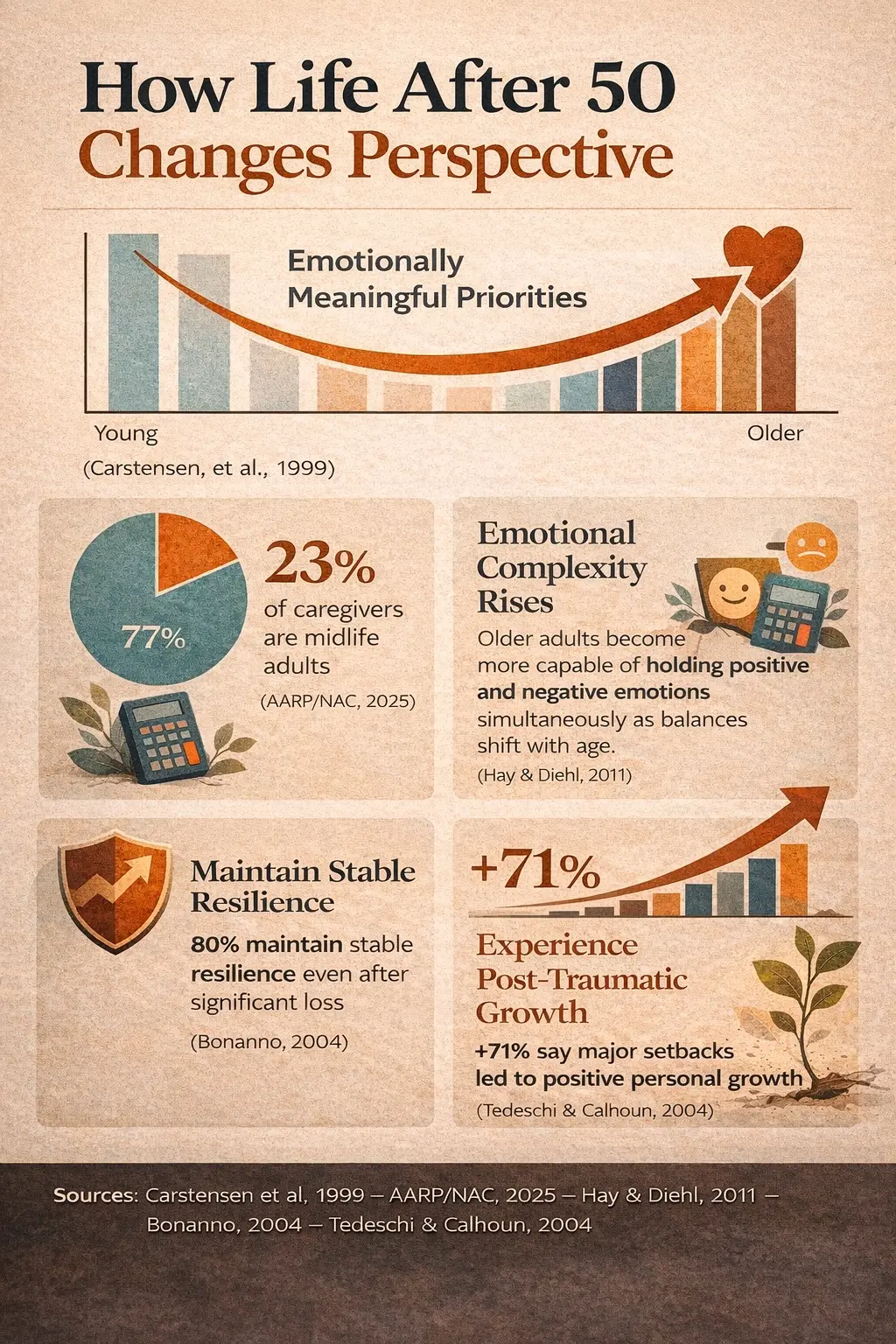
Stanford psychologist Laura Carstensen’s socioemotional selectivity theory suggests that as people perceive time as more limited, they shift their focus toward emotionally meaningful relationships and experiences rather than expansion or status. When the future feels finite, priorities sharpen.
Many adults in this stage are also balancing significant caregiving responsibilities. The 2025 Caregiving in the United States report from AARP and the National Alliance for Caregiving finds that adults over 50 represent a substantial share of unpaid caregivers nationwide.
Responsibility accumulates. So does perspective.
Research in The Journals of Gerontology has found that emotional complexity tends to increase with age, meaning older adults are often more capable of holding positive and negative emotions simultaneously rather than experiencing them as opposites.
Emotional life does not narrow with age.
It deepens.
Refinement, not crisis
The cultural script still frames midlife as crisis or comeback. Decline or reinvention. But that binary misses what many people actually experience.
What I see instead is refinement.
We become less interested in impressing people who are not paying attention.
We become quicker to repair relationships that matter.
We become more willing to let go of roles that no longer fit.
Columbia University psychologist George Bonanno’s research on grief and resilience has shown that many individuals maintain stable psychological functioning even after significant loss, challenging earlier assumptions that prolonged dysfunction is the typical response.
Psychologists Richard Tedeschi and Lawrence Calhoun have also documented what they call post traumatic growth, the idea that adversity can lead to greater appreciation of life, deeper relationships, and increased personal strength.
Growth does not cancel grief. It can exist alongside it.
And maybe that is the quiet recalibration that happens after 50.
You realize that more life is behind you than ahead.
Not dramatically. Mathematically.
And that math rearranges you.
You waste less time.
You tolerate less noise.
You protect your energy.
You choose with intention.
When I think about my father now, I do not only think about the day he died.
I think about the age.
Sixty two.
An age that once felt distant.
An age that now feels close enough to measure against.
Close enough to ask harder questions.
Not about how much time is left.
But about whether I am living it deliberately.
That is the shift no one announces.
It is not panic.
It is not decline.
It is clarity earned through experience.
And once you see time clearly, you do not move the same way again.
Read next

More Features about Wellness

We’re diving headfirst into the science, ethics, and potential societal impact of radical life extension.

Is this the recipe for living healthy and happy beyond 50?

Mark Weiner's lessons for midlife happiness.
Rethinking hunger, habit, and health in my 50s. A quiet moment sparked a powerful shift.
Perimenopause, hot flashes and sleep: one fitness coach shares her experience of a changing body.
If you decide to diet for your health reasons, the first step is to stop looking for quick fixes.

Middle age isn’t the beginning of a slow decline but the spark for a thrilling renaissance.

Sleep and intimacy after 50: exploring menopause, desire and how couples balance rest and connection.