By the time someone reaches 50 there is a good chance they have accumulated something professionally valuable that is difficult to quantify. Former colleagues have moved on. Employees have become executives. Customers have changed companies. Recruiters have changed firms. Someone encountered briefly 15 years ago may now be running a business in an entirely different industry.
We call all of this a network and increasingly we can see it neatly organized on LinkedIn. Hundreds or thousands of names sit behind a number labeled “connections.” A request arrives. We recognize enough common ground to accept and sometimes almost immediately comes the message: Thanks for connecting. I help senior executives who…
Before two people have established why they might want to know each other one has diagnosed the other’s problem and helpfully produced the solution.
It is easy to roll your eyes. It is also worth asking whether that reaction is fair. Coaches need clients. Consultants need business. People looking for work need opportunities. Networking has always involved some degree of self-interest. The more interesting question for experienced workers is not whether someone pitched too quickly on LinkedIn. It is whether we have confused being connected to people with actually having connections to them.
An Advantage We Don’t Talk About Enough
Much of the discussion about older workers understandably focuses on the obstacles they face. AARP research found that 64 percent of workers 50 and older had seen or experienced age discrimination in the workplace while 22 percent said they felt they were being pushed out of their jobs because of their age.
Those numbers are sobering but another body of research points in a more encouraging direction. Research from AARP and LinkedIn found that workers 50 and older have professional networks 20.4 percent larger than younger professionals with more senior people represented among their connections. Older workers also averaged 18.5 years in leadership roles compared with 7.7 years among younger professionals.
Experience in other words produces more than expertise. Over several decades it produces people. Those relationships can become a form of professional capital but only if they remain useful after the circumstances that created them have changed.
When the Phone Gets Quiet
RestlessUrban founder Andrew Bowins discovered that distinction after leaving a long corporate career. For years his professional world included colleagues employees customers journalists recruiters and agency partners across companies and countries. The calendar was full the phone rang and people regularly wanted meetings opinions decisions and introductions.
Then the corporate career ended. The title disappeared the calendar cleared and the phone became considerably quieter. That kind of silence can raise an uncomfortable question for anyone who has occupied a senior position: Were people calling because of the person or because of the chair the person happened to occupy?
The truthful answer is probably both. Titles create their own gravity and senior professionals can easily mistake the activity surrounding a position for an entirely personal network. Remove the position and some of that activity naturally disappears.
That isn’t evidence that those relationships were false. Work brought people together in the first place and when the work changes some relationships change with it. But the experience can reveal an important distinction between having access to people and having relationships with people.
LinkedIn makes that distinction particularly visible. The number beside “connections” doesn’t suddenly collapse when a title disappears. The inbox however may tell a different story.
The People We Barely Know May Matter More Than We Think
It would be tempting to conclude that experienced workers should forget enormous digital networks and concentrate exclusively on people they genuinely know. The evidence makes that argument difficult to sustain.
A major randomized experiment conducted through LinkedIn involved more than 20 million users over five years during which roughly 2 billion new connections were created more than 70 million job applications were recorded and 600,000 new jobs identified through the platform were accepted. Researchers found causal evidence supporting the sociological theory known as the “strength of weak ties”: looser professional relationships can be especially valuable in creating job mobility.
The logic is straightforward. Close colleagues and friends often know many of the same people and possess much of the same information we do. A former coworker from three jobs ago an occasional industry acquaintance or even someone recently encountered on LinkedIn may operate in a completely different professional circle. That person can expose us to information our closest contacts never see.
The findings were more nuanced than simply saying strangers are better than friends. The relationship between tie strength and job transmission was nonlinear and the benefits varied by industry. Moderately weak connections proved especially valuable by some measures.
Think about what that means after 50. The person who helps with whatever comes next may not be an old boss or closest colleague. It could be someone you worked with 12 years ago a former client you occasionally hear from a recruiter you haven’t spoken with in years or the person whose LinkedIn request you accepted yesterday.
Different relationships give us access to different worlds. The person sitting unnoticed among 2,000 LinkedIn connections may turn out to be more relevant to the next chapter than someone spoken to every week.
So Maybe the LinkedIn Stranger Isn’t the Problem
Perhaps accepting a request from someone we’ve never met isn’t superficial networking at all. The research suggests there can be real value in exactly those loose connections. Clicking “Accept” may put two professionals in each other’s networks but it tells us almost nothing about whether a relationship will follow.
Technology has made the introduction almost frictionless but it hasn’t accelerated the formation of trust. Somewhere between Thanks for connecting and Here’s my calendar the simple act of becoming curious about another person can disappear.
There is nothing inherently wrong with the pitch. Coaches need clients. Consultants need business. Job seekers need jobs. Someone offering a useful service should be able to say so. But imagine the same interaction offline. Two people are introduced at an event shake hands and exchange names. One immediately offers to unlock the other’s leadership potential and asks whether Tuesday at 2 works for a 30-minute call.
Most people would find that a little strange. LinkedIn hasn’t necessarily made the behavior less transactional. It has simply made the transaction easier.
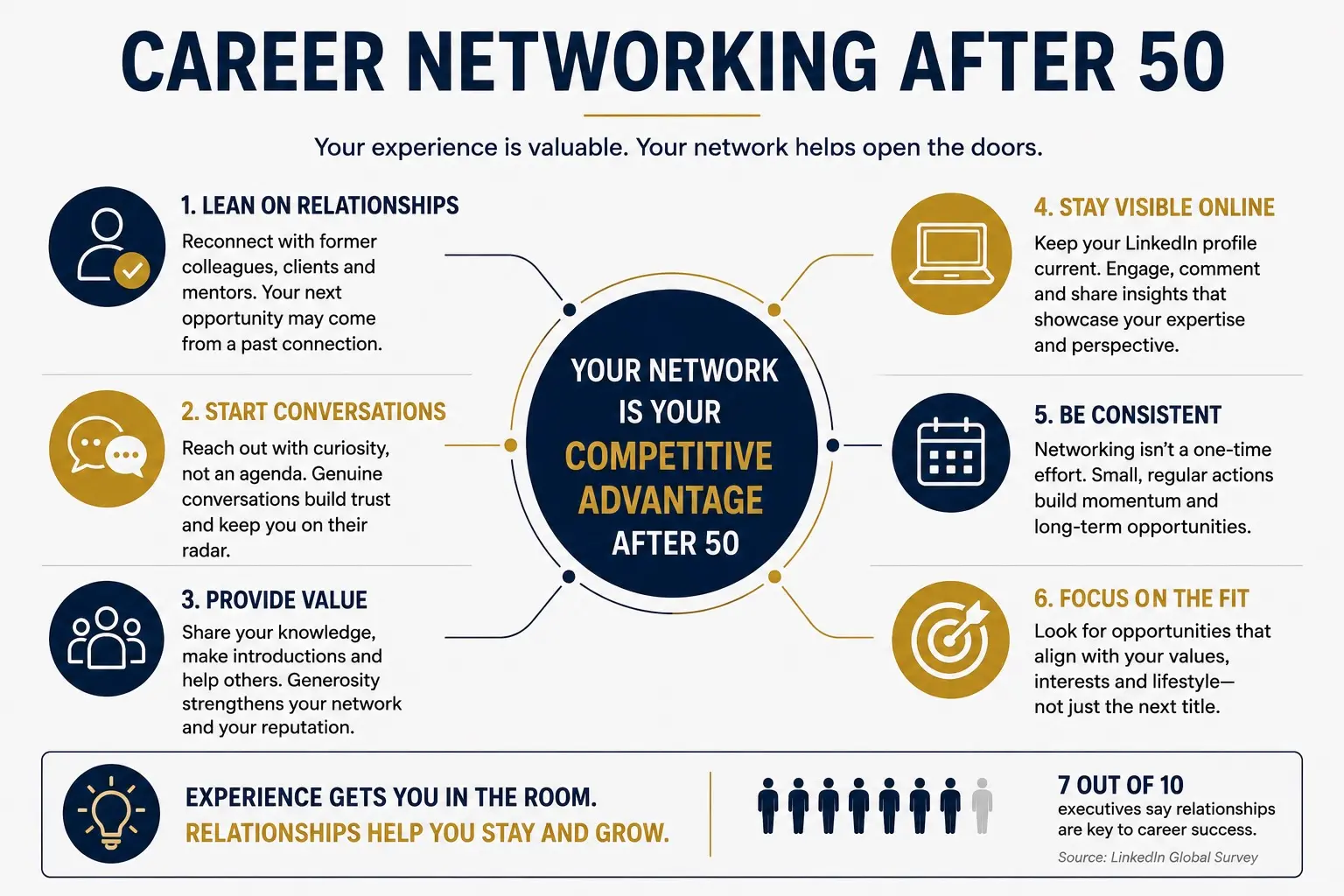
The Opportunity After 50
For professionals over 50 retreating into a small circle of longtime colleagues would squander one of the advantages accumulated over decades. Weak ties matter new connections matter and people at the edges of a professional life may provide precisely the unfamiliar information that leads somewhere new.
The opportunity is to invest in those connections without treating every interaction as an extraction. Reconnect with someone whose career has taken an interesting turn. Call a former colleague without needing anything. Thank someone who helped years ago. Introduce two people who ought to know each other. When someone new connects on LinkedIn find out why they reached out before deciding what they need.
For experienced professionals this isn’t sentimental career advice. It is maintenance of an asset they have spent decades building.
The Metric LinkedIn Can’t Give Us
LinkedIn can count connections with extraordinary precision. It can identify mutual contacts shared employers industries skills and career histories. What it cannot easily tell anyone is who will answer the phone.
That may be a more revealing measure of a network after 50. Who would take the call when the title has disappeared? Who would make an introduction without calculating its immediate value? Who remembers the person rather than merely the position? Just as importantly whose call would that person take?
The research offers an encouraging answer to part of the work-after-50 story. Experienced professionals aren’t entering their next chapter empty-handed. Their networks are larger and more senior and some of the people who matter most to what comes next may not be close friends at all. They may be former colleagues distant acquaintances or even someone whose LinkedIn request arrived yesterday.
Perhaps the challenge after 50 isn’t simply to “work your network.” It’s to recognize what you’ve actually spent decades building and remain open to new connections without reducing every new person to an opportunity.
Because after decades of working the real measure of a network may not be how many people someone can reach. It may be how many relationships are still worth reaching for.
And if the first message after connecting is a sales pitch? Perhaps give it a moment before getting grumpy. The research at least suggests the stranger on the other side may be worth knowing.


More Features about Work

Music changed my life. Playing guitar helped me heal, grow stronger, and embrace change.

Founder Andrew Bowins shares the story behind the creation of RestlessUrban.
Job hunting sucks, that’s a fact. But some have turned Into something collaborative and fun.

Companies that actively invest in retaining and hiring professionals over 50 enjoy clear advantages.

Inspiring second acts from people over 50 who found passion and purpose through flying, teaching, and music.

Music and brain health: How a former chancellor found joy, stress relief, and purpose through daily 90s rock jams.

After 50, the old career rules stop working. Here’s how to build work around the life you actually want.

Artist Gary Holme reinvents himself at 70, proving it’s never too late to reclaim passion and create anew.