I’m still ambitious. I still want to build things, make money, have influence and do work that matters. I still like winning. What has changed after 50 is the price I’m willing to pay for it.
The funny thing is, someone warned me about this years ago. I was in one of those intensive executive leadership programs designed to tell promising leaders who they were, how far they might go and, if you read carefully enough, what might eventually get in their way.
I remember liking most of my assessment. Driven. Ambitious. Decisive. Leadership potential. My trajectory appeared to be pointing exactly where I wanted it to go: up. Then came the warning.
My drive had an edge. I needed to get better at bringing people along. I needed to understand how my intensity affected others and balance my appetite for results with the people responsible for producing them. Left unchecked, the report suggested, some of the qualities propelling me forward might eventually work against me. I could even flame out near the height of my career.
I suspect I paid considerably more attention to “height of my career” than “flame out.” It was Icarus for the corporate world, only with a psychological assessment and an expense account. Years later, I understand the warning better.
The Price of Ambition
I’ve been ambitious for most of my life. Aggressively so, at times. I wanted the bigger job, the harder assignment, more responsibility and a seat at the table. I didn’t exactly object when the title got longer.
Ambition served me well. It took me into fascinating companies and difficult situations. It allowed me to provide for my family, save, invest and eventually have choices the younger version of me didn’t have. I’m proud of that career. This isn’t an apology for ambition. It’s an acknowledgment that I didn’t always understand what ambition was costing me.
For a long time, intensity felt almost entirely virtuous. Set the goal higher. Move faster. Solve the problem. Grow. Deliver. Repeat. When that formula keeps working, you don’t spend much time examining the formula. With some distance, however, I can admit something I probably couldn’t have admitted then: sometimes my determination to reach the destination made me less attentive to the people making the trip with me.
I rushed conversations that deserved more time. I pushed some people harder than I needed to. I sometimes treated my urgency as though everyone around me should experience it exactly as I did. There were moments when the person sitting across from me needed something different from their leader than another objective. None of that was intentional, but intent isn’t the only measure of leadership.
I became very good at asking, “What do we need to accomplish?” I wasn’t always as good at asking, “How are we doing while we accomplish it?” That’s harder to write than anything I’ve written about ageism, hiring or Corporate America because there’s no convenient villain in that sentence. There’s just me.
The View From the Other Side
That realization has also changed how I think about the end of my corporate career. I’ve written before about my last boss and HR partner, and I still believe there were things they could have handled differently. Time hasn’t magically made every decision look wise. But distance has allowed me to ask a question I wasn’t asking when I was living through it: What did I miss?
We were three experienced people with strong résumés and, presumably, good intentions. Somewhere between the interviews, expectations and pressure to deliver, we didn’t understand one another well enough. We knew what each other had accomplished. We knew considerably less about how we would lead together, navigate disagreement or respond when things became difficult.
I own that lesson as much as anyone. Maybe we were so busy determining whether I could do the job that none of us spent enough time determining whether we could actually do the job together. That’s something I wish I’d understood earlier, and something I’d tell anyone considering a career move after 50.
At this age, getting the job shouldn’t be the only test of success. Knowing the people you’re choosing to work with, and letting them really know you, may matter as much as the résumé that got everybody into the room. Experience ought to make us better at recognizing fit, not simply better at getting hired.

Ambition Has Somewhere Else to Go
Here’s where things get interesting. I haven’t lost my ambition. I still want to build things, make money and do consequential work. I haven’t suddenly developed an overwhelming desire to garden. I’m just less certain that I need another promotion, which is convenient considering nobody has offered me a job in quite a while. Apparently the job market and I have reached an understanding.
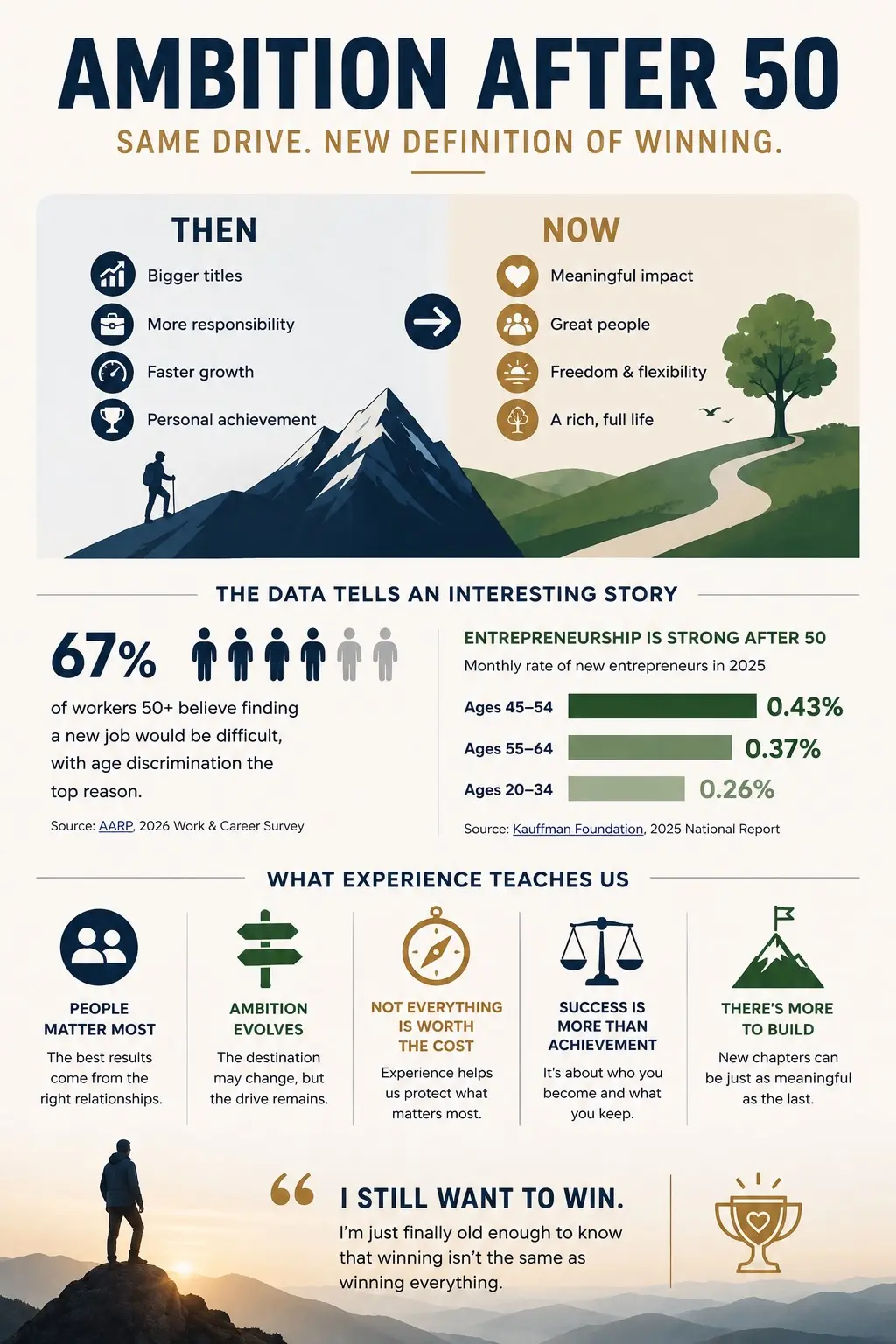
There is a more serious reality underneath the joke. A 2026 AARP survey found that 67% of workers 50 and older believe finding a new job would be difficult, with age discrimination the most commonly cited reason. At the same time, Kauffman Foundation data show that entrepreneurship is hardly reserved for the young. In 2025, the monthly rate of new entrepreneurs was 0.43% among Americans ages 45 to 54, compared with 0.26% among those ages 20 to 34. Adults ages 55 to 64 also outpaced the youngest group, at 0.37%
Those are very different statistics, and we shouldn’t force them into a tidy story. Plenty of experienced people want jobs and can’t find them. Entrepreneurship isn’t a consolation prize for age discrimination. But perhaps there’s another story developing alongside that one: maybe ambition after 50 isn’t disappearing. Maybe it’s looking for somewhere better to go.
Mine certainly is. I’ve served on boards, studied happiness and well-being simply because I was curious, become more serious about investing and built RestlessUrban. In the past 18 months, we’ve reached more than 5 million people. The younger me would have looked at that number and immediately asked how quickly we could make it 10 million.
The current me still asks. Some wiring apparently survives personal growth.
But now there are other questions competing for airtime. Am I enjoying this? Am I learning? Who am I doing it with? Is this making my life richer or simply busier? What else deserves some of the energy I’ve spent decades directing toward work? Those questions aren’t evidence that I’ve become less ambitious. I think they’re evidence that my ambition has become more selective. It now has to earn its place.
The Next Definition of Winning
Perhaps that’s the opportunity after 50. Take the job. Build the company. Ask for the promotion. Consult. Invest. Teach. Start over. Learn something you’re terrible at. There is nothing inherently enlightened about making ourselves smaller simply because we’ve accumulated more birthdays.
But experience should give us something youth couldn’t: the ability to recognize that not everything worth having is worth what it costs.
I don’t regret my ambition. It gave me a career I’m proud of, allowed me to provide for people I love and eventually gave me the freedom to build something different. I just wish I’d understood sooner that success isn’t only about what you accomplish. It’s also about who is still beside you, who you became along the way and whether what you gained was worth what you gave up.
So perhaps the more interesting question after 50 isn’t whether Corporate America still wants us. It’s what we want now. What deserves another decade of our attention? What are we still hungry enough to chase? What are we finally confident enough to walk away from? And what might we build if we stopped measuring the next chapter against the last one?
Those are the questions I want to spend more time exploring because I still want to win. I’m just finally old enough to understand that winning isn’t the same thing as winning everything.
And yes, if somebody does eventually offer me a job, I’m still willing to hear the compensation package. Some wiring survives personal growth.


More Features about Work

Music changed my life. Playing guitar helped me heal, grow stronger, and embrace change.

Founder Andrew Bowins shares the story behind the creation of RestlessUrban.
Job search after 50: Phyl Terry's Never Search Alone and the support of collaborative Job Search Councils.

Companies that actively invest in retaining and hiring professionals over 50 enjoy clear advantages.

Inspiring second acts from people over 50 who found passion and purpose through flying, teaching, and music.

Music and brain health: How a former chancellor found joy, stress relief, and purpose through daily 90s rock jams.

Career change after 50: rethinking work-life balance, encore careers and what meaningful work looks like.

Artist Gary Holme reinvents himself at 70, proving it’s never too late to reclaim passion and create anew.