
When I was first promoted to vice president, a mentor walked with me toward my first board meeting. I was nervous, probably trying very hard not to look nervous, when he put his arm around me and offered some advice I’ve carried ever since.
Nobody in that room was inherently smarter than I was, he told me. Everyone was earning their seat at the table. Be decent, but provoke. Ask questions. Challenge.
It wasn’t permission to be the loudest person in the room. It was something more consequential: a reminder that getting a seat at the table came with an obligation to use it.
Years later, I found myself in a room with Jeff Bezos during a complicated moment. Plenty of people around him had opinions about what he should do. My recollection is that at one point he looked across the room, past some of the people advising him, and essentially asked me: What should we do?
So I told him what I thought. Maybe he valued an outside perspective. Maybe he wanted to hear something different. Or maybe being Canadian finally paid off. We have spent generations perfecting the art of disagreeing with someone while sounding vaguely apologetic.
Whatever the reason, the moment stayed with me because he didn’t seem particularly threatened by disagreement. That instinct is embedded in Amazon’s leadership principles. “Have Backbone; Disagree and Commit” calls on leaders to respectfully challenge decisions when they disagree and then commit once a decision is made. Bezos also described the practice in his 2016 shareholder letter.
It sounds obvious. In practice, disagreement is where corporate culture gets complicated.
Experience Is Valued. At Least on Paper.
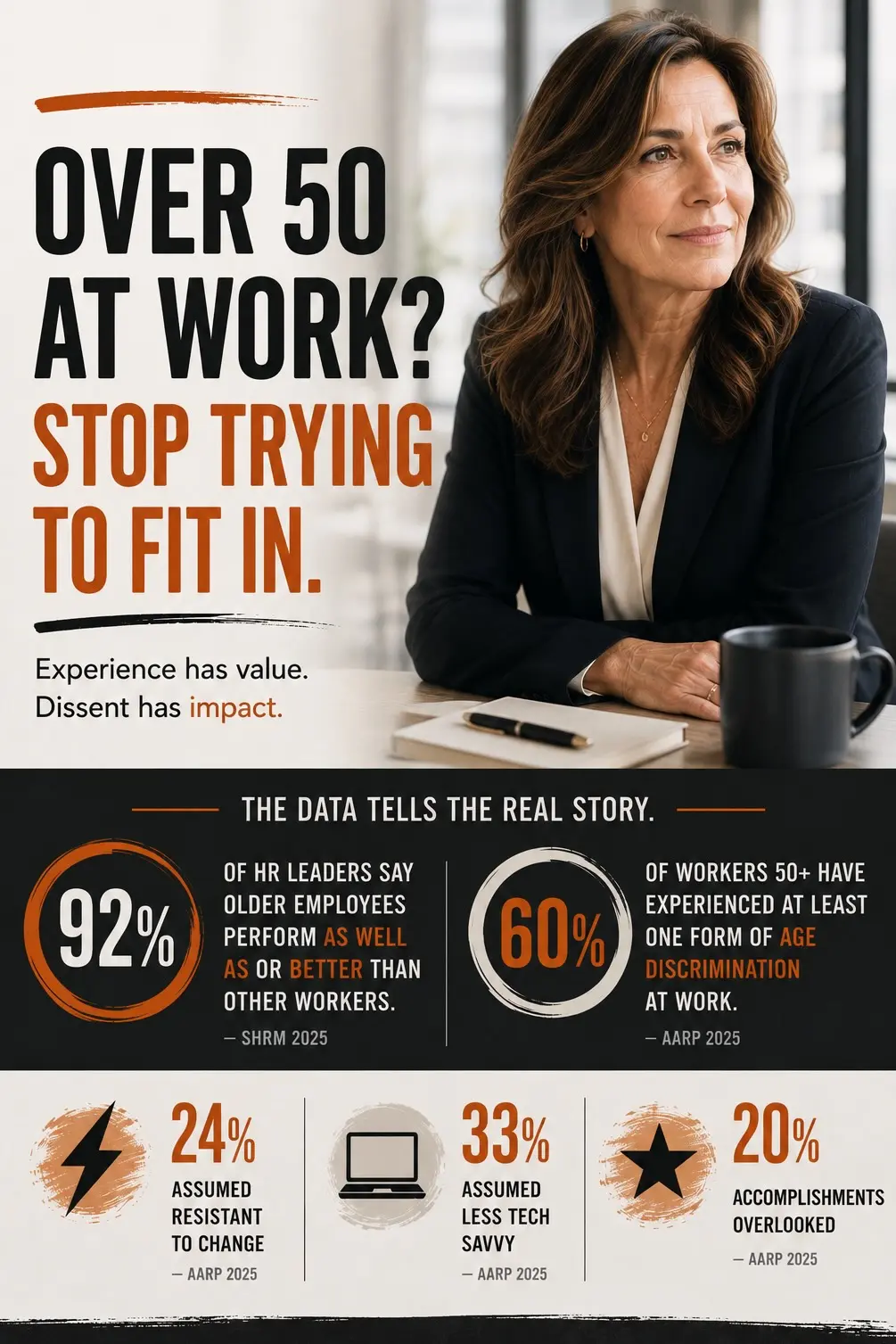
There is little evidence that older workers somehow stop contributing. Recent SHRM research on older workers found that 92% of HR professionals who have worked with older employees believe they perform as well as or better than other workers. Among workers ages 18 to 54 who have worked alongside older colleagues, 88% say the same.
Yet AARP’s research on workplace age discrimination exposes an uncomfortable contradiction. Sixty percent of workers 50+ reported experiencing at least one subtle form of age discrimination. A third encountered assumptions that older employees were less technologically capable, 24% encountered the assumption that older employees resisted change, and 20% said their accomplishments or expertise had gone unacknowledged.
That phrase, “resistant to change,” interests me because sometimes resistance isn’t resistance. Sometimes it’s disagreement.
I Didn’t Fit In
I learned that distinction the hard way. In my last corporate role, my boss and HR partner ultimately decided I wasn’t the right fit. With some distance, I can admit something I probably couldn’t have admitted then: they weren’t entirely wrong. I didn’t fit in.
I struggled with “this is how we do things here.” My instinct was to ask why we did them that way in the first place. I pushed. I questioned. Sometimes I was probably a pain in the ass, and I wasn’t particularly interested in becoming another version of the people already sitting around the table.
At times, the team felt to me like corporate clones. Same language. Same instincts. Same definition of what “good” looked like. When I didn’t quite conform, words like culture and fit entered the conversation.
Sometimes those disagreements had real consequences. There were people on my team I was asked to manage out. I refused. I believed they were good people doing good work who needed support, not an exit plan, so I backed them. Last I knew, they were still there and doing well.
I don’t tell that story to prove I was right and my boss was wrong. Management is rarely that tidy. She saw things I didn’t, and with some distance I can recognize that I contributed to my own outcome. But it left me with a question I haven’t completely resolved:
At what point does culture fit stop protecting a healthy culture and start protecting sameness?
Maybe both things were true. I didn’t fit. And maybe fitting wasn’t always what the job needed.

Experience Isn’t the Same as Being Right
There’s another side to this, and those of us over 50 need to own it. Experience isn’t a permission slip for stubbornness. We’ve all encountered the executive whose response to every new idea is some variation of “We tried that before.”Longevity alone doesn’t make someone wise.
If anything, experience should make us less certain. Stay around long enough and you’ll watch brilliant people embrace terrible ideas. You’ll see consensus confused with correctness and beautifully presented strategies quietly disappear six months later. You’ll probably champion a few bad ideas yourself. I certainly have.
What experience can provide is something subtler: pattern recognition, context and judgment, along with enough scar tissue to know that the smartest person in the room can still be spectacularly wrong.
My teenage daughter has already mastered the questioning part. Why? Why not? Who decided that? Does that actually make sense? There are moments when I desperately want her to just accept the answer, and then I hear my mentor’s voice and realize I’m asking her to stop doing exactly what I’ve spent a career believing good leaders should encourage.
Parenting has an irritating way of exposing inconsistencies in your management philosophy.
Answers Are Getting Cheaper
AI makes this more consequential. Machines can summarize information, organize arguments and produce polished recommendations at extraordinary speed. The ability to generate something that sounds authoritative is becoming commonplace.
But asking whether we’re solving the right problem is different. So is recognizing the pattern everyone else has missed or having the courage to tell a powerful person, respectfully, I think you’re wrong.
Answers are getting cheaper. Good questions aren’t.
Perhaps that’s what Corporate America should reconsider about people over 50. Don’t hire decades of experience and then ask those people to behave exactly like everyone already in the room. And those of us over 50 shouldn’t mistake experience for entitlement either. Our responsibility is to bring judgment without arrogance, dissent without obstruction and conviction without losing the ability to change our minds.
My mentor had a simpler formulation: be decent, but provoke. I still haven’t heard much better leadership advice.
Maybe the goal after 50 isn’t figuring out how to fit in again. Maybe it’s knowing when the room needs you not to.


More Features about Work

Music changed my life. Playing guitar helped me heal, grow stronger, and embrace change.

Founder Andrew Bowins shares the story behind the creation of RestlessUrban.
Job hunting sucks, that’s a fact. But some have turned Into something collaborative and fun.

Companies that actively invest in retaining and hiring professionals over 50 enjoy clear advantages.

Inspiring second acts from people over 50 who found passion and purpose through flying, teaching, and music.

Music and brain health: How a former chancellor found joy, stress relief, and purpose through daily 90s rock jams.

After 50, the old career rules stop working. Here’s how to build work around the life you actually want.

Artist Gary Holme reinvents himself at 70, proving it’s never too late to reclaim passion and create anew.