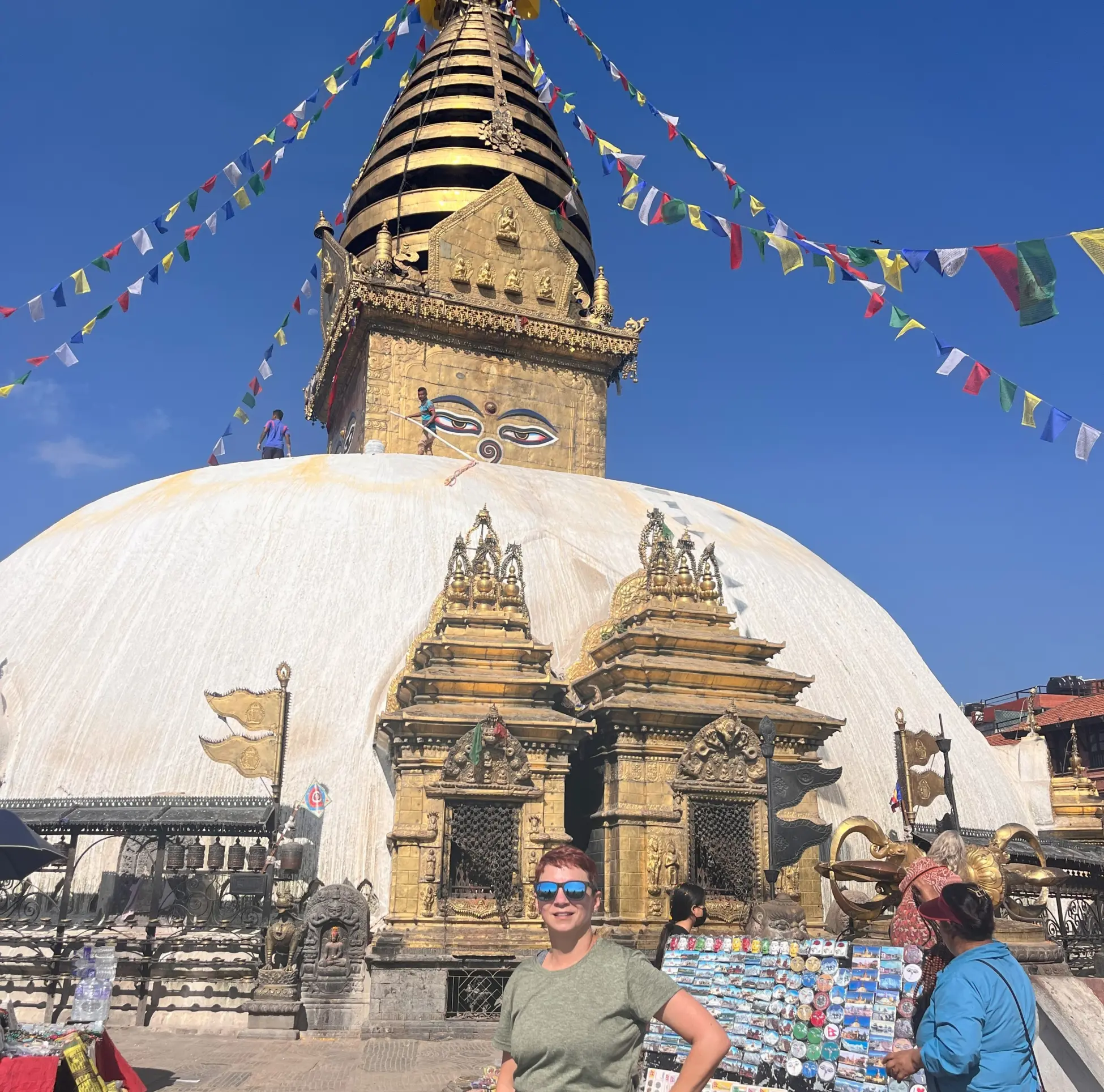
Visiting the Swayambhunath Stupa, a holy pilgrimage site for both Hindus and Buddhists, which is sometimes called the Monkey Temple because of the abundance of monkeys living in the area.
I’m walking alone through a city I’ve never visited before. The lanes are overflowing with people and every form of transport imaginable, none paying heed to the few traffic signals that seem to exist. None of the streets have English-language signs to tell me their names. It makes little difference since I have no map.
This was not a nightmare. It was real life in the city of Kathmandu, and I was full of main character energy. And possibly some overconfidence in my sense of direction. But I’d paid attention as a tuk-tuk driver, arranged by my tour company, delivered me earlier to Durbar Square to see the many temples there. And I had 52 years of experience being headstrong and determined.
But to explain how I got there, I have to go back a few years.
How I Got to Nepal
From the first step, this journey had been impulsive. It started in 2020, when I saw a small, locally owned trekking company called Prime Himalayas offer 50% off a future Nepal trip to generate some income while the world was locked down. No expiration date. Buy now, travel later.
I bought it thinking I would make the trip the next year. Then one year turned into two, which gave me more time to research, dream, and quietly panic as I learned 3,000 stone steps were waiting for me on day one of the 5-day Himalayan trek.
But I also discovered in all that research that trekking in Nepal’s Annapurna region is far more accessible than it sounds. The trails are dotted with family-run lodges called teahouses, which means you never have to sleep in a tent or cook over a camp stove. For a modest additional fee, a porter will even carry your heavy pack between stops, so you hike with nothing but a day bag. The altitude on the Poon Hill route, which I booked, stays between 3,500 and 10,500 feet — challenging, but not the kind that sends most people reaching for oxygen.
None of that made those stairs any easier, though.
Lots of people ask me how I trained for the trek, and the honest answer is that I really didn’t. I already had a habit of getting a couple of miles through a combo of walking and running most days. I thought I would add in some extra time going up and down the stairs in my house, but that didn’t really happen.

No matter how many times he guides trekkers to the top of Poon Hill, Bhim Banjara remains amazed by the beauty and proud to share the Annapurna range of Himalayan mountains with them.
It turns out that what I needed more than physical training was a mental shift.
The Himalayas conjure images of remote, snow-blasted peaks. What I actually trekked through for five days was lush, tropical foliage, terraced rice paddies, forests thick with ferns, and waterfalls tumbling across the path. Dahlias and marigolds grew wild along trails also used by mule caravans hauling propane tanks up to mountain villages.
Our guide’s mantra was bistāri, bistāri — slowly, slowly. And that consistently gentle reminder to slow down was the necessary shift in both my thinking and my actions.
I stopped frequently to catch my breath, which I chose to reframe as stopping to take photos. The mules passed me with a sidelong look that suggested they did not understand my excuse, but the scenery really was breathtaking. Our human group was small, just four foreigners, our guide, and two porters. But having the group to chat with through the harder stretches, to debate our favorite Amazing Race episodes and play the alphabet game with places we’d traveled, was a big help. It’s remarkable what a welcome distraction competitive geography is when your heart is pounding in your head.
And we were far from the only group on the trails. Over the five-day trek, we frequently crossed paths with small and large groups from all around the world. There was a family that had hired porters to carry their small children in baskets when they got tired, and a couple in their 70s using this as training for an Everest Base Camp trek. Every evening after dinner in the teahouses presented another opportunity to meet interesting people, like a group of Nepalese high schoolers on a field trip that invited us to join them in Bollywood dancing around a fire pit. Thank goodness for ibuprofen to get me back on the trail the next morning!
If this sort of adventure sounds amazing, but out of your comfort zone, I would encourage you to rethink that.

Below the famous snowy peaks of the Himalaya lies an abundance of lush green forest and many waterfalls, such as the one draped here with Tibetan prayer flags.
How To Plan Your First Trek
I thought I was a bit impetuous when I booked my first trekking trip, but one member of our group arrived without so much as a pair of hiking boots. Luckily for her, Nepal is one of several places where you can find well-established routes and strong logistical support for trekking. There were numerous local vendors happy to sell us anything we’d forgotten to pack.
If you’re not confident in your fitness, start small, like I did with just 5 days on the trail and a couple on each end in the cities of Kathmandu and Pokhara. Even the least fit of our group, whom I half expected to turn back on day one, managed to reach the highest teahouse on our route with the patient encouragement of our guide.
Other places known for their trekking infrastructure include New Zealand, with its eleven premier hiking tracks they call “Great Walks,” and Peru, with the famous Inca Trail and less-well-known Salkantay Trek, which offers a 5-day option. I’ve got my sights set next on the Tour du Mont Blanc, a unique hike which takes around 7 to 10 days to complete, passing through Italy, Switzerland, and France. Similar to Nepal’s teahouses, it is set up for hut-to-hut trekking.
All of these established routes mean there is less uncertainty for first-time and solo travelers who like to navigate on their own. But they also mean there are many tour operators available to make it more than doable for even the most inexperienced. Many now offer women-only group options and solo-friendly bookings. While I hiked with a group during the day, I had a private room to relax in each evening without an exorbitant “solo tax” that you often face when booking tours priced for double-occupancy.
You can also spend a small fortune on gear for this sort of trip, but you don’t have to. Everyone on the trail is there for the scenery, not a fashion show. Pack basic layers that can take you from warm foothills to cold peaks — and that can be washed in the sink and hung communally to dry with your neighbors’.. Since a porter carried my large duffel bag, I simply repurposed my daughter’s old high school dance team pack as my day bag.
Good boots are a must-have, but the expensive bacteria-filtering water bottle I purchased was unnecessary. Trekking poles are a personal preference. Many people swear by them, and I opted to buy a pair after arriving in Kathmandu, but I found them unwieldy for climbing. A single pole did prove useful to me on the downhill to help establish a sure footing and avoid slipping in mud (or worse, mule and buffalo poop).
But gear only gets you so far. What stays with you longer is the place itself.

Land of Never Ending Peace and Love
Hinduism is the dominant religion of Nepal, although a large statue of the Buddha, who was born there, greets you at the airport. You see the Hindu influence in the multitude of temples, small and large, and in their respect for nature, and even how the country presents itself to visitors. A popular acrostic spells out NEPAL: Never Ending Peace and Love.
If Nepal — or any trek like it — has been living on your someday list, filed under trips for someone younger, fitter, or more adventurous than you, I’d invite you to reconsider. The trails have good infrastructure and great people. The porters are strong, the guides are patient, and bistāri, bistāri turns out to be excellent life advice whether you’re above the clouds or just finding your way through an unmapped city street.
On my way back to the hotel that afternoon in the chaos of Kathmandu, which I eventually reached on instinct and stubbornness, I noticed several tattoo shops. When I returned from the mountains, another impulse led me back to one of them, and I came out with an unalome: the Buddhist symbol for the path to enlightenment, nonlinear and looping but always moving forward.

The colorful Kaal Bhairav is a Hindu shrine located in Kathmandu Durbar Square, Nepal.
Laura Pevehouse writes about wandering — literally and figuratively — at WhereTheWindBlows.Me. Her full account of the Poon Hill trek, including day-by-day terrain, teahouse details, and a guide to the temples of Kathmandu, lives there.


More Features about Culture
How a night at sea and a quiet gift in Paris taught me the secret to living.

At 50, life is just getting started. Meet the generation redefining aging with bold moves and big adventures.

Exclusive preview of title track and feature video free for a limited time.

Bold stories of reinvention. Singer-songwriter Dean Brandsma

Meet Marleah. Unfiltered, raw and curious explorations of life.

Leaving home at 53 was not a crisis. It was my chance to reinvent life after the empty nest and rediscover freedom.
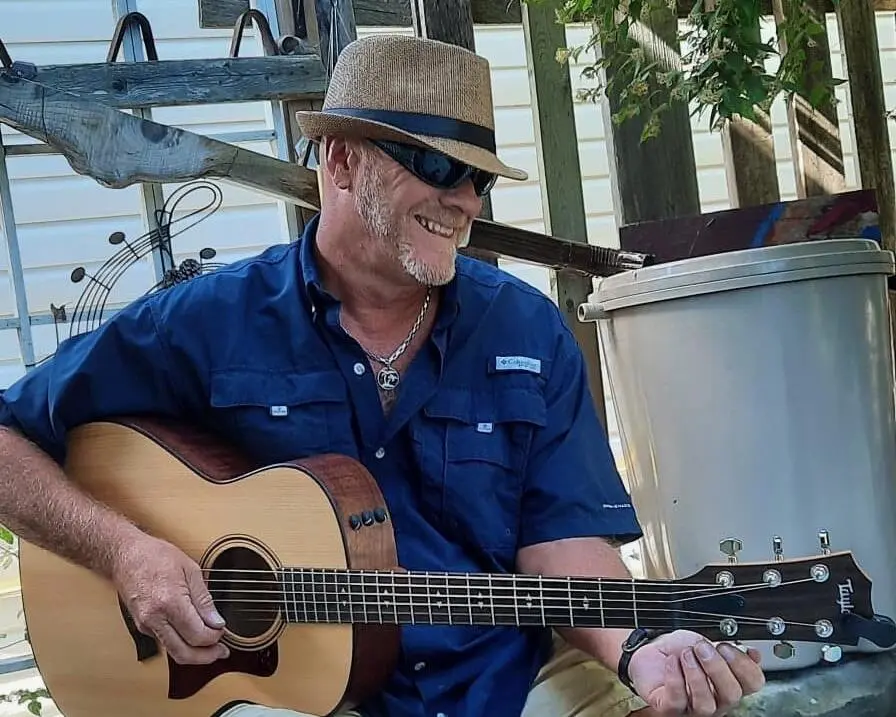
Singer-songwriter Dean Brandsma rewrites his life’s soundtrack. Hear the story behind the song Crossroads.

Style after 50 is not about rules. It’s about confidence, emotion, and embracing who you are right now.