There is an enormous industry waiting for you when you’re 22. Universities prepare you for work. Career centers help you find it. Recruiters introduce you to employers. Companies create training programs to help you advance. There are internships, graduate programs, job boards, career coaches, professional networks and enough advice about writing a résumé to keep LinkedIn busy indefinitely.
Then you turn 55, and much of that machinery gets considerably quieter. You may still have 10, 15 or even 20 productive years ahead of you. You may know more about your industry, people and business than you ever have. You probably still need to make money. You may want another job, but you might also want to consult, start something, work less, work differently or combine several of those things.
For a population with that much experience and that many possible working years ahead, the menu feels surprisingly limited. Much of the system still points toward two destinations: find another full-time job or start preparing to retire. There is an awfully large amount of life between those choices. At 59, I’m living in it, and the more I look around, the more I wonder why we haven’t built more around it.
We Have a Career System With a Missing Middle
For most of my working life, the rules were pretty easy to understand. You entered somewhere near the bottom, developed expertise, took on more responsibility and hopefully moved up. Compensation generally followed. Eventually you reached the senior levels of your profession and, at some socially acceptable age, began thinking seriously about retirement.
Most of the infrastructure around work still reflects that progression. Recruiting helps people find jobs. Corporate development programs prepare employees for larger jobs. Professional networks help people find the next opportunity. The financial industry spends enormous amounts of time helping us prepare for the day we stop working. What we haven’t built nearly as well is everything between peak career and retirement.
That is becoming a fairly important gap. People are living and working longer, careers are less linear, and technology is changing what one person can accomplish without a large organization behind them. Yet when someone reaches 55 or 60, we still tend to ask a question that sounds as if the previous 30 years never happened: What’s your next job? Sometimes that’s exactly the right question. I’m just not convinced it should be the only one.
I Didn’t Realize I Was Entering This Gap
At 56, after more than three decades working inside large companies, I started RestlessUrban. It was the first company I had ever built, and I didn’t arrive with a grand theory about longevity or the future of work. I wanted to see whether I could build something that mattered to people like me.
I had spent my career at companies including Dell, Nokia, Mastercard, Samsung, KPMG, Entertainment Software Association and Cisco. I knew communications, reputation, brands, audiences and large organizations. Then I started a media company and discovered a fairly impressive list of things I didn’t know: publishing technology, audience development, advertising economics, subscriptions, SEO, analytics, video, AI and the small matter of generating revenue. There was no orientation program, although there was Google, which I suppose is the modern equivalent.
What surprised me wasn’t how much I had to learn. It was how little infrastructure existed to help someone take 30 years of professional experience and use it in a substantially different way. Starting a business requires financial flexibility and tolerance for risk that many people don’t have and plenty of sensible people don’t want. But it made me notice something I hadn’t thought much about during my corporate career: We spend decades helping people accumulate professional capital and remarkably little time helping them figure out how to deploy it differently.
Look at Everything We Built Around Retirement
The contrast becomes obvious when you look at retirement. We have 401(k)s, IRAs, target-date funds, annuities, retirement calculators, financial advisers, Social Security strategies and an entire industry designed around the period after work. That’s not a criticism. People need help preparing for retirement, and getting it wrong can be enormously expensive.
But where is the equally developed system for the 58-year-old who expects to work until 70 but doesn’t want those 12 years to look like the previous 30? What does financial planning look like when income moves between salary, consulting and business ownership? Where are the professional marketplaces that assemble experienced people around a problem rather than matching one person to one permanent job? What does serious professional education look like for a 57-year-old who doesn’t need another degree but does need to understand how AI can be applied to 30 years of expertise?
There are companies addressing pieces of these problems. What I don’t see yet is a mature ecosystem connecting them. Maybe that’s because we’ve spent so long assuming the period immediately before retirement is simply the tail end of a career rather than a distinct economic stage of its own.
The People Are Already Moving
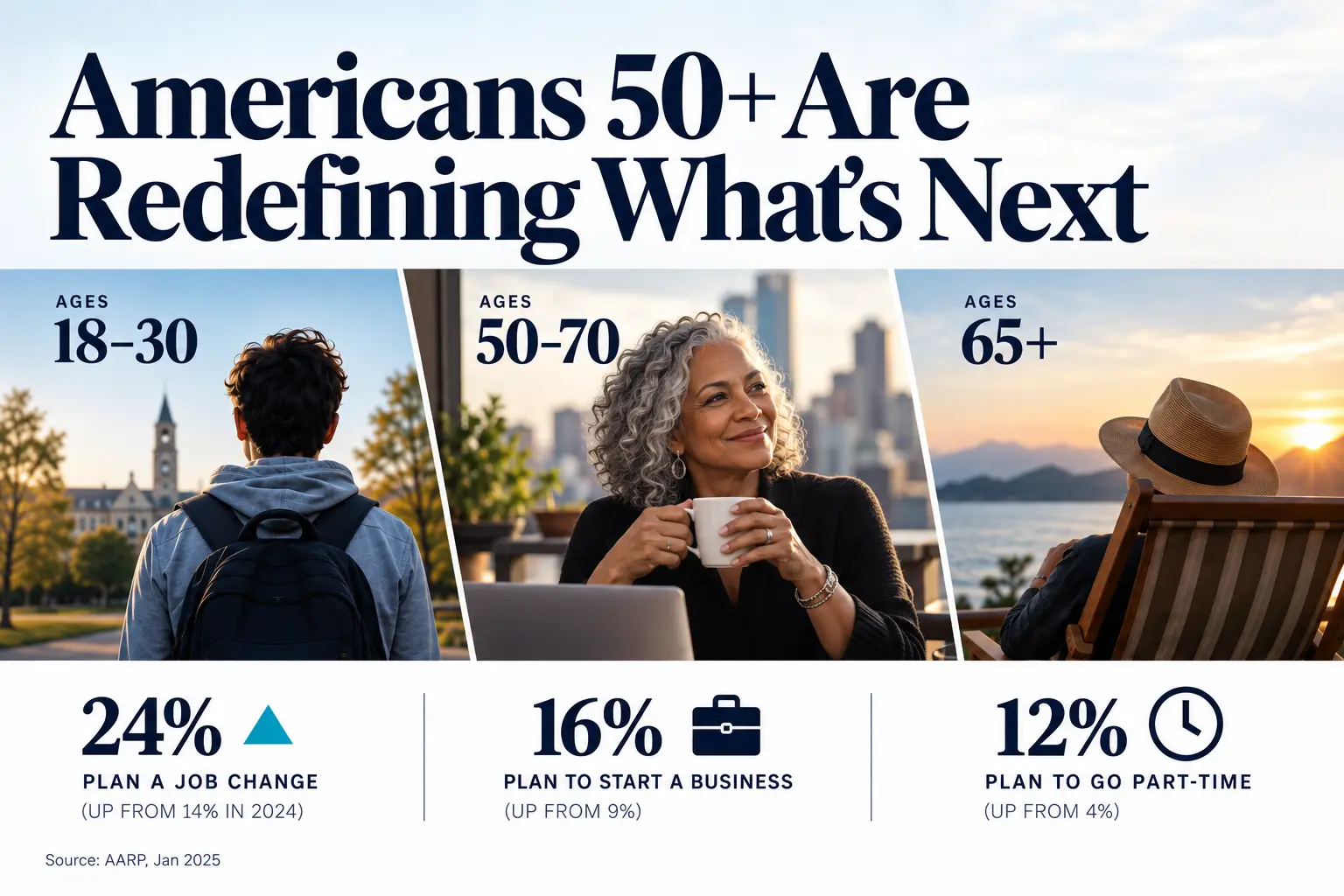
The behavior of workers over 50 suggests something is changing. An AARP survey of workers 50 and older heading into 2025 found that 24% were planning a job change, up from 14% a year earlier. Among those considering a change, 16% planned to start a business, up from 9%, while 12% planned to move from full-time to part-time work, up from 4%.
Those numbers shouldn’t become a story about everyone over 50 abandoning corporate life to open a vineyard. Making more money was the leading motivation for considering a change. That matters because work after 50 is still work. Mortgages remain stubbornly uninterested in personal transformation.
What the numbers suggest is that people approaching traditional retirement age aren’t behaving as one economic group. One 58-year-old needs another full-time job. Another wants consulting clients. Someone else wants to buy a business. Another needs employer-sponsored health insurance badly enough that everything else is secondary. We tend to put all of those people into a category called “older workers.” Economically, that category is becoming less useful.
AI Changes the Economics
Most conversations about AI and older workers begin with a reasonable concern: Can experienced workers learn the technology quickly enough? Of course we should learn it. Being 59 doesn’t come with a technological exemption.
But I’m becoming more interested in the opposite question: What does AI allow an experienced person to do without a traditional employer?
Think about the infrastructure a professional once needed around them. Research, analysis, marketing, design, presentations and administrative work often required teams or departments. AI doesn’t eliminate the need for expertise, but it can reduce the cost and complexity of putting that expertise to work. The World Economic Forum’s Future of Jobs Report 2025 projects substantial labor-market change through 2030 as technology, demographics and other forces reshape employment. For experienced professionals, one consequence may be greater ability to operate independently.
That possibility deserves more attention. A person who once needed a large organization to provide the infrastructure around their expertise may increasingly be able to assemble some of that infrastructure themselves. For people in the latter part of their working lives, that could fundamentally change the economics of what comes next.
There Is a Business Here
If millions of people are going to spend longer in this period between peak career and retirement, somebody is going to build products and services for them. The question is whether we recognize the opportunity early enough to build things they actually need rather than simply repackaging retirement products with younger-looking stock photography.
There could be better marketplaces assembling experienced executives into temporary operating teams. Financial products could accommodate income moving between employment, consulting and entrepreneurship. Benefits could become more portable. Universities could build serious programs for experienced professionals combining existing expertise with emerging technology. Companies could maintain networks of former senior employees who return for specific projects without returning permanently.
AI products present another opportunity. Most technology is marketed around efficiency, but there may be an entirely different market in helping one experienced professional turn what they know into a viable small business, consultancy or specialized service. None of this requires the death of the full-time job. It simply acknowledges that after 50, one job with one employer may no longer be the only useful container for decades of accumulated knowledge.

We Shouldn’t Pretend Everyone Gets to Choose
There is one part of this conversation that bothers me whenever it gets too optimistic. Not everyone gets to design a beautiful portfolio life. Someone who loses a job at 58 may need another paycheck immediately. Health insurance can dictate decisions. Entrepreneurship requires capital. Consulting can be unstable. Caregiving responsibilities can reduce options, and age discrimination doesn’t disappear because we invent a better vocabulary for working differently.
I’ve written enough about work after 50 to know that telling someone who can’t find a job to “reinvent themselves” can sound less like encouragement and more like an insult. This isn’t an argument that everyone should become an entrepreneur, consultant or fractional executive. It’s an argument that a working life lasting 40 or 50 years probably requires more options than the systems around it currently provide.
We Built the Retirement Economy. What Comes Before It?
At 59, I’m in a professional category I wouldn’t have known how to describe 10 years ago. I’m working, building a company, learning new technology and using things I learned decades ago, sometimes all before lunch. I’m not retired, but I’m also not trying to recreate the career I had at 45.
I suspect there are millions of people somewhere in that territory, each with different financial circumstances, ambitions and definitions of what they want from work. That’s why I think the more interesting opportunity in the 50+ economy may not be what companies can sell us as we get older. It may be what gets built to help us remain economically active in ways that fit lives that no longer follow the old career script.
We spent decades building a sophisticated economy around retirement. Financial services figured it out. Real estate figured it out. Travel figured it out. Health care certainly figured it out. I’m curious who is going to build the economy around the 15 years before it.
At RestlessUrban, we’re exploring what life after 50 actually looks like across work, wellness, culture and the choices that don’t fit neatly into the old script. If you’re navigating it too, come join us. There’s a lot more to talk about.


More Features about Work
Music changed my life. Playing guitar helped me heal, grow stronger, and embrace change.
Founder Andrew Bowins shares the story behind the creation of RestlessUrban.
Job hunting sucks, that’s a fact. But some have turned Into something collaborative and fun.

Companies that actively invest in retaining and hiring professionals over 50 enjoy clear advantages.

Inspiring second acts from people over 50 who found passion and purpose through flying, teaching, and music.

Music and brain health: How a former chancellor found joy, stress relief, and purpose through daily 90s rock jams.

After 50, the old career rules stop working. Here’s how to build work around the life you actually want.
Artist Gary Holme reinvents himself at 70, proving it’s never too late to reclaim passion and create anew.