


The rubber duck has long been a signature throw, and parade float, of the Krewe of Muses.
A Different Kind of Mardi Gras
Recently, as some friends and I were leaving New Orleans’ Le Petite Theatre’s performance of the play Blithe Spirit, a group of people likely consuming quite a few spirits began shouting from a balcony, asking if we wanted them to throw us some beads. They probably thought us spoilsports when we ignored them and muttered to ourselves about “tourists,” but I already had six cases of beads in the trunk of my car!
With a reputation for drunkenness and a bit of debauchery, mature adults may think that Mardi Gras is not the time for them to visit the “City That Care Forgot.” I would counter that Mardi Gras isn’t something you age out of; it’s something you finally have the wisdom to experience properly. Let my friends and I show you how.
Although a native of Louisiana, I grew up in the mostly Protestant northeastern part of the state, at a time when Mardi Gras, with its Catholic roots, wasn’t really celebrated there. But, with a little help from New Orleans natives and some trial and error on my own, I’ve learned a thing or two about how you can get the most out of this wonderful season in New Orleans – and a season it is, not just a day.
Carnival Season Begins in January
Mardi Gras officially kicks off on Epiphany, January 6. When most of the world is taking down their Christmas decorations and bracing for the dull, dreary part of winter, New Orleans simply transitions from the green and red to the purple, green, and gold. Trees, wreaths, and garlands can stay up – you just change the ornaments and lights.
It starts small like that, but as the season progresses toward its eponymous Fat Tuesday, momentum builds. First, the King Cake begins to appear – don’t come at New Orleans with your New Year’s diets. Here are a few rules you need to know about King Cake:
Don’t eat any before Epiphany. That’s bad luck.
After you cut into one, leave the knife in the box until the last slice is gone.
If you get the baby, or whatever cute token your baker has chosen to include with the cake, it is your responsibility to buy the next cake.
Because when you start celebrating Mardi Gras season from its beginning, you have more time to enjoy multiple King Cakes. Which you need because there are so many different kinds these days! Luckily, you don’t have to run all around town to find them – just visit the King Cake Hub, which brings some of the area’s best bakeries together in one place.
Skip Bourbon Street and Explore the Real Routes
Place is something that also matters when it comes to what type of Mardi Gras you experience. Remember those tourists on the balcony? They were in the French Quarter, which is where most first-timers end up and where the stereotype comes from, but those first-timers may be surprised when they find out the large “superkrewe” parades haven’t actually rolled through the Quarter since 1973.
The parades that do still reach the French Quarter are the smaller ones that come early in the carnival season, such as Krewe de Jeanne d’Arc, with its members dressed as 15th-century French townspeople. Or the Intergalactic Krewe of Chewbacchus (a play on the superkrewe Bacchus), which attracts not only fans of Star Wars, but general Sci-Fi, fantasy, and all “super nerds.”
Some other popular parades during this early part of the season include Krewe Boheme, “an unconventional collection of artists and merry makers” that celebrates the bohemian vibe of the Marginy community, where it originates. And there is the highly irreverent and satirical Krewe du Vieux, a collective of 17 sub-krewes that create lewd, horse-drawn floats skewering politicians, celebrities, and whatever topic of the day might be a good target.
These are now some of my favorites because of the DIY spirit they display. You can tell the members marching past have put their heart, soul, and a lot of time into the creative costumes and displays. Many of them also bring a more homemade and sustainable mindset to the things they hand out along their route, such as glass beads instead of the more common plastic ones.
It’s an earth-friendlier trend that is expanding to the larger-float krewes, as well. Last year, I came away with a bag of jambalaya mix and a pair of socks from Krewe of Freret, as well as a reusable tote bag. The New Orleans City Council pushed this sort of change even further when they recently banned single-use plastic beads, with an exception for those that carry custom krewe logos.
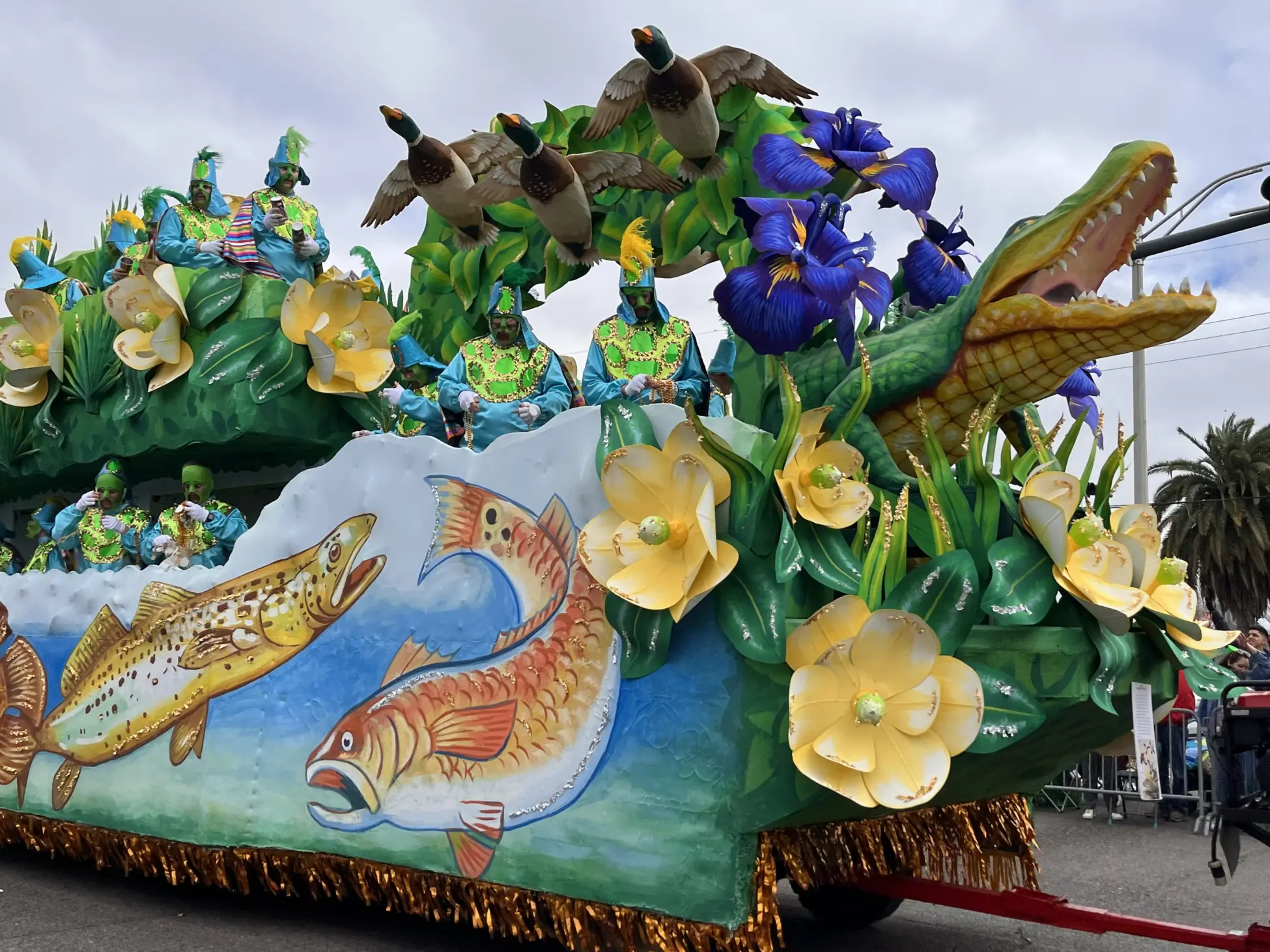
Elaborate Mardi Gras floats bring parade themes to life at larger-than-life size.]
Head Uptown for the Full Parade Experience
And if catching as many of those beads as possible is your goal while at Mardi Gras, then you need to get out of the Quarter and into my favorite part of town – Uptown. This is where my native New Orleans friends spend most of their Mardi Gras time, and many of their families book the same apartments or hotels on or near the parade route year after year.
Uptown New Orleans, by a historic definition, is everything upriver from Canal Street. It generally encompasses the Garden District, Irish Channel, Freret, Audubon, and University areas. But for the purposes of parade watching, what you need to remember is that St. Charles Avenue runs through its heart.
And while the heart of St. Charles is the world’s oldest continuously operating streetcar line, you’ll want to get your rides on it before parade days see the “neutral ground” be taken over by families and friends who stake out space to watch parades that start early in the day and run into the night. It’s here that, as the carnival season gets closer to Fat Tuesday, the floats get closer to God. Instead of small floats pulled by bicycles, the Uptown parades have multi-level and multi-part (tandem) floats filled with masked riders.
It’s there, under the broad branches of ancient oak trees, that you can watch miles of ornate floats pass by with fewer barricades between you and those coveted throws. You will have to look for space that’s not filled with dozens of decorative ladders, however. These unique solutions allow children to sit above the heads of the adults for an enviable view of the floats.

Originally created to provide young children a way to see above the adults at parades, Mardi Gras ladders have begun to fill the St. Charles Avenue route.
If you want an equally good view, as well as the benefit of a restroom, and sometimes food and drinks, then you should look into tickets for balconies or grandstands along the parade route. There is a wide variety of options, from restaurants to hotels and even corporate offices, some of which offer handicap viewing locations. They can vary in cost depending not only on location, but also by the day, with more popular parades commanding higher prices. Pro tip: To enjoy different parade views, book different locations each day you plan to be there.
Attending Mardi Gras as an adult not tied to school schedules or work obligations means you can hit the sweet spot between the walking parades and the superkrewes. Two weekends prior to Fat Tuesday, there are lots of great parade options and fewer tourists. Once you hit the Thursday before Fat Tuesday, the number of parades and the size of the crowds start to get more intense.
But if you want to lean into the extravagance and the revels of Mardi Gras, it’s prime time. This is when some of the top women’s krewes roll, such as Iris, Muses, and Cleopatra. Other parades, such as Endymion and Bacchus, are known for giant, light-up floats and celebrity guests. One of the newer super krewes, Orpheus, rolls on the previously quiet Monday known as Lundi Gras and also offers everyone a chance to purchase tickets to attend their after-party. But, be prepared for an early start to the next morning if you want to catch Rex, King of Carnaval, and the Zulu parade.
Pace Yourself and Plan Smart
It’s a lot. But it’s all about pacing yourself. And here are a few other tips that can help ensure you “pass a good time,” as New Orleanians say:
- Book lodging early. If you’re thinking of attending this year, you’re too late unless you want to stay out of town and drive in each day. If you want to go next year, start looking into reservations as soon as this year’s Mardi Gras has passed.
- Don’t get “boxed” out, or in. When booking lodging, be aware of what parades might be rolling on the day you arrive or leave and whether their routes will cause road closures that could end up putting your hotel inside a box you can’t drive into. Pro tip: Download the WDSU Parade Tracker app to not only see the routes, but also watch in real-time the beginning and end of each parade.
- Watch where you park. Parking on a street that is part of a parade route is a good way to get yourself towed. These will be marked, so pay attention to the signs. And parking garages in the Central Business District do not fool around if you go over the time you purchase. I once arrived at my car 20 minutes past the time I had purchased upon entrance, only to find my car booted and my wallet $100 lighter to leave. Pro tip: If parking for Uptown parades, Walter L. Cohen High School sells space that includes a bathroom pass.
- Bathrooms may be hard to find. There aren’t a lot of public porta-potties, and most businesses will restrict their bathrooms to paying customers. This is when having a balcony or grandstand spot can be a real benefit.
- Be ready to stand and walk a lot. This is not the time to choose cute shoes over comfortable ones. If you don’t have seating reserved along the route, you might want to carry a folding chair. Sometimes there can be long breaks between parades or even within one if a float breaks down, and you’ll want to rest. It could also be a good time to pop into a bar, restaurant, or daiquiri shop.
- Keep some cash on you. Some of those daiquiri shops or other small businesses in New Orleans are cash-only establishments. This is not just a Mardi Gras thing, either, so good to remember if you come at another time. Pro tip: To make sure you keep as much of that cash as possible, never take a bet with someone who says they can tell you where you got your shoes.
- Watch for flying throws. You want to catch the beads, cups, socks, and shoes, but you don’t want to catch them with your face, so always be on the lookout for flying objects when a float is passing by you. And don’t bend over to pick things up. Not only might they be in a gross bit of “party gravy,” but it’s also a good way to get your fingers stepped on.
- Dress up! There is no such thing as too much sparkle when you attend Mardi Gras parades. This is your chance to wear wigs, wild headdresses and hats, and all sorts of clothing in purple, green, and gold. If you love to wear costumes, the walking parades are especially known for a crowd that is as on-theme as the krewe members with their attire. The weather in New Orleans during Mardi Gras can swing widely from warm to cold, sunny to rainy, but while it’s hard to predict, there are plenty of local stores ready to sell you more sparkly clothes to meet your needs.

Mardi Gras is the time to sparkle. Don’t be afraid to have fun.
The Spirit of Mardi Gras
With all of this information, you can confidently plan your own Mardi Gras adventure. But if the logistics or crowds still feel like too much, you can experience Mardi Gras from the comfort of your own home. There are many streaming options available that let you watch the floats roll by from your couch.
One of my New Orleans friends told me that when she was a kid, her dad would put the parades on TV and then stand behind it to throw beads at them while they watched. It’s a pretty good metaphor for Mardi Gras itself—sometimes the magic is in creating your own version of the tradition.
Which brings me back to those six cases of beads in my trunk. They weren’t souvenirs from parades I’d attended—they were ammunition for a parade I was about to ride in. This weekend, I’ll be on a float in Baton Rouge with a group of my friends from college, throwing those beads to crowds lining the streets of Louisiana’s capital city.
Mardi Gras has spread well beyond New Orleans, but the city remains the heart of it all. It’s the place where the tradition runs deepest, where the krewes have marched for generations, where the season genuinely transforms the city for two months every year. One last pro tip: make time to visit The Historic New Orleans Collection – A free museum and research center devoted to the people, places, and traditions of New Orleans that has a great exhibit on the history of Mardi Gras.
Whether you’re watching from a St. Charles Avenue balcony, walking alongside a krewe in the Marigny, or throwing beads from a float in another Louisiana city entirely, Mardi Gras offers something I’ve come to appreciate more with age: a reminder that community celebration doesn’t have to make sense to be meaningful. It just has to be joyful, creative, and maybe a little bit excessive.
The young people on Bourbon Street will figure that out eventually. The rest of us already know.
More Features about Play

Go ahead—crack a smile. Your middle-aged heart will thank you.

A guide to midlife travel that celebrates curiosity, culture, and the art of reinvention after 50.

Live like a local in France where slow travel, solo discovery, and midlife reinvention meet by the Seine.

Bold accessories turn simple outfits into statements. Style tips and standout finds for life after 50.