
I spent more than 30 years in corporate communications, marketing and reputation. For most of my adult life, I had a title attached to my name. I had teams, deadlines, budgets, problems to solve and enough meetings about meetings to last several lifetimes.
Then that chapter ended.
Today, I’m an entrepreneur building RestlessUrban, and I love what I’m doing. But I’d be lying if I said I completely stopped looking over my shoulder at my old corporate life.
Every once in a while, I still reach out to someone from that world. Partly because I care about the work. Partly because I’m curious. And partly because every entrepreneur should probably have a backup plan in case the brilliant idea turns out to be considerably less brilliant than originally advertised.
Not that I’m planning to need one. Confidence and delusion have always been close cousins.
Recently, I emailed a recruiter I’d known and trusted for years. His response was warm and encouraging. Something about it also seemed strangely familiar.
So I searched my inbox.
There it was. He had sent me essentially the same response nearly five years earlier.
Copy. Paste. Send.
In those five years, my corporate career had ended. I’d started a company. My relationship with work had completely changed.
Apparently, I hadn’t earned an updated paragraph.
I laughed. Mostly.
But it also reminded me how much our relationship with work changes when we’re no longer sitting in the job.
The Part The Unemployment Rate Misses
The headline numbers can make things look relatively reassuring for older workers. But unemployment rates only tell us how many people are looking for work. They don’t tell us nearly enough about what happens once they’re out.
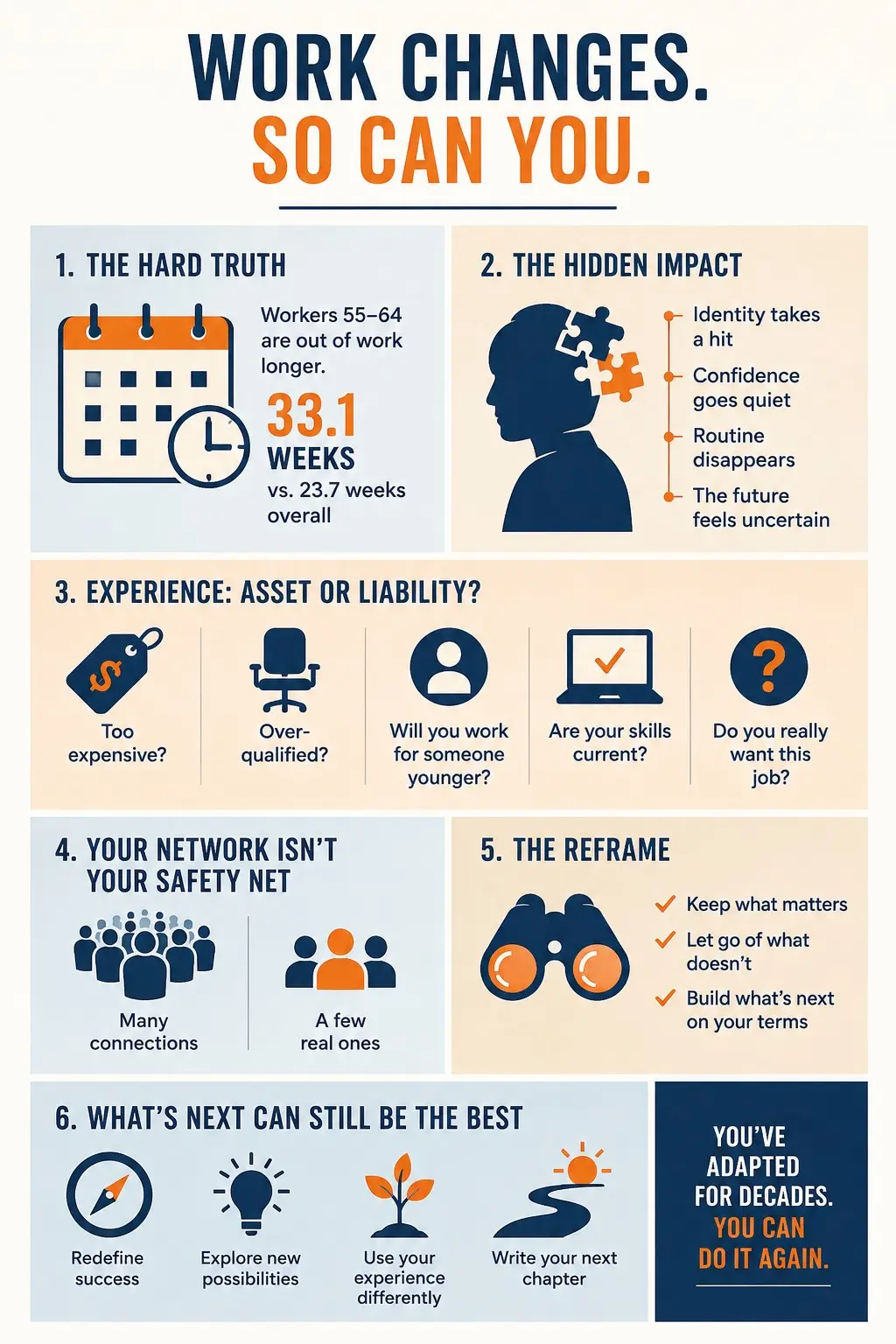
In July, unemployed Americans ages 55 to 64 had been out of work for an average of 33.1 weeks, compared with 23.7 weeks for unemployed workers overall, according to the U.S. Bureau of Labor Statistics.
Seven or eight months without a paycheck is difficult at any age. At 55 or 60, it comes with different baggage. Retirement is closer. There may still be a mortgage. Kids may need help. Parents may need help. And health insurance can suddenly become a topic capable of ruining an otherwise perfectly good Tuesday.
But I think there’s something even harder to measure:
What happens to your sense of yourself when Monday morning suddenly has nowhere for you to go?
We spend decades being told not to define ourselves by our jobs. Then somebody takes away the job and we discover just how much defining was going on.
The Strange Shock Of Being Experienced
You would think experience would make all of this easier.
After 30 years, you’ve probably survived a recession or two. You’ve worked for great bosses and terrible ones. You’ve watched strategies come and go, companies merge, technologies change and management theories get renamed so they can be sold again.
You’ve learned things that aren’t easily captured in a job description: when to push, when to wait, when someone is bluffing, when a problem is actually a crisis and when everyone just needs to go home and look at it again tomorrow.
Then you start looking for work and discover that experience can create its own questions.
Are you too expensive? Are you overqualified? Will you work for someone younger? Are your skills current? Do you really want this job?
Age discrimination is not theoretical. In a 2026, AARP survey on age discrimination in the workplace, 64 percent of workers age 50 plus said they had seen or experienced it at work. Another 22 percent said they felt they were being pushed out because of their age.
I don’t believe every rejection after 50 is ageism. Sometimes somebody else is better. Sometimes our skills need updating. Sometimes we’re bringing 30 years of experience to a job designed and budgeted for 10.
But pretending age never enters the equation feels equally ridiculous.
And there’s another possibility worth considering.
Sometimes the job market has trouble seeing our value.
Sometimes we have trouble explaining it.
When Confidence Gets Quiet
There’s another part of unemployment that doesn’t appear in the monthly jobs report.
Confidence.
At RestlessUrban, we’ve written about imposter syndrome and confidence after 50. It’s easy to imagine that decades of success permanently settle the question of whether we’re good enough.
They don’t.
Send enough applications into the void and almost anyone starts wondering. The first rejection is business. The tenth is frustrating. Somewhere around the twentieth, it can begin to feel personal.
That’s dangerous because a hiring process is answering a very narrow question: Does this organization want this person for this particular job right now?
It is not answering the much larger question:
Do I still matter?
We shouldn’t confuse the two.
Maybe The Goal Isn’t Getting Your Old Career Back
This is where my thinking has changed.
When a career gets disrupted after 50, the instinct is often restoration. Find another version of the job. Replace the salary. Recover the title. Put everything back where it was.
Maybe that’s the wrong objective.
Perhaps the more interesting question is: Which parts of my old working life are actually worth taking with me?
The judgment? Keep it. The relationships that turned out to be real? Absolutely. The ability to solve difficult problems? Bring that too.
The status anxiety, endless meetings and belief that your title tells people who you are?
Maybe those can stay behind.
In, We Survived Dial Up, We’ll Survive This!, Shane McLaughlin explored what happens when experienced workers are suddenly forced to adapt again.
It’s easy to forget how much change people over 50 have already absorbed. We learned computers, email, the internet, smartphones, social media, remote work and now AI. We’ve spent much of our working lives adapting to something.
We’re probably capable of doing it again.
Your Network Gets Smaller. That’s Not Always Bad.
Losing a job also has a remarkable ability to audit your address book.
When you’re in a good position, people call. Recruiters check in. Former colleagues suggest lunch. LinkedIn tells you that you have several thousand professional friends.
Then circumstances change.
Some people show up. Some don’t.
I used to think that was disappointing. Now I think it’s useful information.
As Shane explored in, Never Search Alone, the people who matter during a career transition aren’t necessarily the people with the biggest titles or the largest networks. They’re the ones who make an introduction, review your résumé, challenge a bad idea or simply answer the phone.
Maybe 5,000 connections were never the goal.
Maybe five real ones are.
There Is Life After The Business Card
Here’s the part I wish we talked about more.
Finding work after 50 can be hard. Starting over can be humbling. And there are legitimate questions about whether our hiring systems know how to recognize decades of experience.
But none of that means the best years of our working lives are necessarily behind us.
We have some responsibility for what happens next. We need to stay current. Learn AI. Try new things. Stop presenting our careers as museum exhibits and expecting everyone else to be impressed by the admission price.
Thirty years of experience is history.
What you do with those 30 years next is value.
And that’s where I find some optimism.
The next chapter doesn’t have to restore everything we had before. It can be smaller. Bigger. More meaningful. Less impressive at cocktail parties. More entrepreneurial. More flexible. Or simply different.
I’m discovering that myself.
Maybe the real opportunity after 50 isn’t getting our old lives back.
Maybe it’s finally having enough experience to decide what parts of them we still want.
Tell Us What Happened To You
If work changed unexpectedly for you after 50, we’d like to hear the part that doesn’t appear on your résumé.
What surprised you? What did you lose besides the paycheck? What helped you find your footing again? And did the next chapter turn out differently than you expected?
Share your story with RestlessUrban or join the conversation in the comments. Someone reading it may be sitting at home on a Monday morning wondering what comes next.
It might help them to know that sometimes what comes next turns out to be pretty damn good.


More Features about Work

Music changed my life. Playing guitar helped me heal, grow stronger, and embrace change.

Founder Andrew Bowins shares the story behind the creation of RestlessUrban.
Job hunting sucks, that’s a fact. But some have turned Into something collaborative and fun.

Companies that actively invest in retaining and hiring professionals over 50 enjoy clear advantages.

Inspiring second acts from people over 50 who found passion and purpose through flying, teaching, and music.

Music and brain health: How a former chancellor found joy, stress relief, and purpose through daily 90s rock jams.

After 50, the old career rules stop working. Here’s how to build work around the life you actually want.

Artist Gary Holme reinvents himself at 70, proving it’s never too late to reclaim passion and create anew.